The October 2026 issue of Dental Bytes covers a flu season reminder for dental teams,…
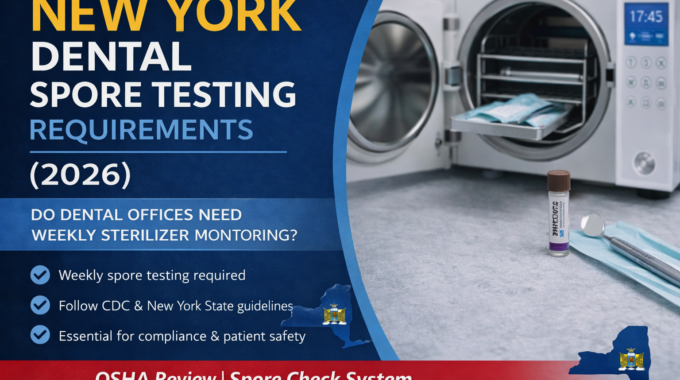
New York Dental Spore Testing Requirements (2026 Guide)
What New York Actually Requires — and Where the Requirement Lives
The New York dental spore testing requirements do not live in a dental board rule. New York licenses dentists through the State Education Department and the Board of Regents, and the infection control duty sits in the Regents’ rules on unprofessional conduct — a single paragraph that applies to dentistry alongside medicine, nursing, podiatry and dozens of other health professions.
That paragraph is unusually detailed. It lists specific sterilization practices by name. What it does not do is name a testing interval — so the weekly spore test comes from the professional standard the rule points to, and from your sterilizer’s own instructions.
The Governing Rule: 8 NYCRR § 29.2(a)(13)
Part 29 of the Rules of the Board of Regents defines unprofessional conduct. Section 29.2 applies to the health professions, and the list expressly includes dentistry, dental hygiene and registered dental assisting. Paragraph (a)(13) makes it unprofessional conduct to fail:
“to use scientifically accepted infection prevention techniques appropriate to each profession for the cleaning and sterilization or disinfection of instruments, devices, materials and work surfaces…”
The rule then says those techniques “shall include but not be limited to” a list of specific practices. The ones that bear on sterilization:
- Sterilizing equipment and devices that enter the vascular system or other normally sterile areas of the body
- Sterilizing equipment and devices that touch intact mucous membranes — or using high-level disinfection where the item cannot be sterilized
- Cleaning all equipment and devices with appropriate agents, including detergents, before sterilization or disinfection
- “Maintaining equipment and devices used for sterilization according to the manufacturer’s instructions”
- “Adequately monitoring the performance of all personnel, licensed or unlicensed,” for whom the licensee is responsible, regarding infection control techniques
Two of those carry more weight than they first appear to. The manufacturer’s-instructions clause makes the sterilizer’s own manual part of the legal standard. And the personnel clause puts the dentist on the hook for what the assistant running the autoclave actually does.
Section 29.5, the special provisions for dentistry and dental hygiene, adds nothing on infection control — it applies all of § 29.2 to dentists and then addresses unrelated matters such as specialty advertising.
So how often is spore testing required in New York?
“Scientifically accepted infection prevention techniques” for sterilizer monitoring means at least weekly biological monitoring of every sterilizer. That is the recommendation in the CDC’s Guidelines for Infection Control in Dental Health-Care Settings, the CDC’s best practices for sterilization monitoring, and the CDC’s Summary of Infection Prevention Practices in Dental Settings. New York does not adopt a CDC document by reference — the rule sets a standard in its own words, and the CDC is the obvious evidence of what that standard is.
Check your sterilizer’s instructions for use as well. Because § 29.2(a)(13) requires sterilization equipment to be maintained “according to the manufacturer’s instructions,” any monitoring the manufacturer specifies becomes part of what New York expects of you.
Biological monitoring is one of three types of sterilization monitoring. Mechanical and chemical indicators show the cycle ran; only the biological indicator shows it killed resistant spores. Test weekly, per sterilizer, including backup units, and after any repair.
How the Rule Is Enforced: Education Law § 6509 and § 6511
The Regents’ rule connects to discipline through the Education Law. Education Law § 6509 defines professional misconduct for every licensed profession, and two of its paragraphs reach an infection control lapse:
- § 6509(9): “Committing unprofessional conduct, as defined by the board of regents in its rules” — which is exactly what § 29.2(a)(13) is.
- § 6509(2): practicing “with gross negligence on a particular occasion or negligence or incompetence on more than one occasion.” Repeated missed spore tests fit the second half of that sentence without needing to be gross.
Education Law § 6511 sets the penalties the Board of Regents may impose:
- Censure and reprimand
- Suspension — for a fixed period, or partial suspension until the licensee completes retraining in the area concerned
- Revocation or annulment of the license
- A fine of up to $10,000 on each specification of charges the licensee is found guilty of
- A required course of education or training
- Up to 100 hours of public service
Fines are counted per specification, so a case charging several distinct infection control failures can multiply the total. An unpaid fine can be recovered by the Attorney General in court, where the Regents’ findings are “conclusive proof of the violation and the penalty assessed.”
Records: Six Years for Patients, No Stated Period for Sterilization
Paragraph (a)(3) of the same Regents rule requires a record for each patient that accurately reflects evaluation and treatment, retained for at least six years — longer for minors, until one year after the patient turns 21. New York sets no specific retention period for sterilization or biological monitoring logs.
Our suggestion: keep sterilization logs at least as long as patient records. If a patient complaint surfaces years later, the log is how you show the instruments used on that patient came out of a sterilizer that was passing its tests at the time.
Federal OSHA Covers New York Private Practices
New York has an OSHA State Plan, but it covers public employees only. According to OSHA’s New York State Plan page, the Public Employee Safety and Health (PESH) Bureau of the New York Department of Labor covers state and local government workers. Private dental practices are inspected by federal OSHA under the bloodborne pathogens standard, 29 C.F.R. § 1910.1030. A dental clinic run by a county, a city or a SUNY campus falls under PESH instead.
The overlap with § 29.2(a)(13) is substantial — gloves, masks, eyewear, sharps containers and spill cleanup appear in both — so a single lapse can be a federal OSHA matter for the employer and a licensure matter for the dentist.
What to Document
New York’s rule does not prescribe the contents of a sterilization log, so build it to answer the two questions § 29.2(a)(13) raises: were the sterilizers working, and were your staff doing it right? Capture:
- Date of each biological indicator test
- Which sterilizer was tested, identified specifically
- Cycle type and parameters
- Result — pass or fail
- Who ran the test — the rule makes staff performance your responsibility
- Corrective action after any failure, and the confirming pass that returned the unit to service
- Maintenance performed under the manufacturer’s instructions
If a Spore Test Fails
If a biological indicator comes back positive:
- Take the sterilizer out of service immediately.
- Recall and reprocess everything sterilized since the last passing test.
- Retest, checking operator technique and loading first — procedural error is the most common cause.
- If the retest also fails, keep the unit out of service until it is inspected, repaired according to the manufacturer’s instructions, and returns a pass.
- Document every step, including the failure. A documented failure handled correctly shows the “scientifically accepted” technique working as intended.
New York Compared with Its Neighbours
- New Jersey writes weekly testing into its own regulations.
- Massachusetts refers to “CDC guidelines, including weekly spore testing” in its dental board rule.
- Connecticut makes failure to follow the most recent CDC dental guidelines a named statutory ground for discipline.
- Vermont has no infection control rule at all and relies on its unprofessional conduct statute.
New York sits between these. It has a real rule with specific sterilization duties, but it defines the standard as “scientifically accepted” technique rather than naming the CDC or an interval.
Common Compliance Mistakes in New York Dental Offices
- Looking for a dental board infection control rule and concluding there is none — the duty is in the Regents’ rules, 8 NYCRR § 29.2
- Treating the sterilizer manual as optional, when the rule makes it the maintenance standard
- Monitoring the primary sterilizer only and leaving backups untested
- No record of which staff member ran each test, when the rule makes staff performance the licensee’s responsibility
- Returning a sterilizer to service after a failure without a documented passing retest
- Assuming New York’s state OSHA plan, rather than federal OSHA, covers a private practice
New York Spore Testing Requirements — Quick Checklist
- Weekly biological indicator test on every sterilizer, as scientifically accepted practice
- Sterilizers maintained according to the manufacturer’s instructions
- Staff infection control technique monitored, and the monitoring documented
- Patient records retained at least six years (longer for minors); sterilization logs kept at least as long
- Failed spore test: unit out of service, items recalled, retested, documented
- Bloodborne pathogens obligations met under 29 C.F.R. § 1910.1030 (federal OSHA)
How OSHA Review Helps New York Dental Offices Stay Compliant
OSHA Review’s Spore Check System is weekly mail-in biological monitoring with the recordkeeping handled for you — a documented, third-party record that your sterilizers passed, week after week. The system is endorsed by multiple state dental associations.
- Pre-barcoded kits — no lab account to set up
- Laboratory-verified results by email or fax
- Full sterilization history available 24/7 for inspections
- Follow-up reminders if a test is not received within 14 days
- A microbiologist available at no charge if a test comes back positive
See how New York compares with the rest of the country in our state-by-state sterilizer monitoring guide.
Regulatory Sources
- 8 NYCRR Part 29 — Unprofessional Conduct (§ 29.2(a)(13) infection prevention; § 29.2(a)(3) patient records; § 29.5 dentistry)
- Education Law § 6509 — Definitions of professional misconduct
- Education Law § 6511 — Penalties for professional misconduct
- CDC — Guidelines for Infection Control in Dental Health-Care Settings (2003)
- CDC — Summary of Infection Prevention Practices in Dental Settings
- CDC — Best Practices for Sterilization Monitoring
- 29 C.F.R. § 1910.1030 — Bloodborne Pathogens Standard
- OSHA — New York State Plan (PESH)
This guide is general compliance information, not legal advice. New York defines the standard as “scientifically accepted” technique, which moves as the science does — verify current CDC guidance, your sterilizer’s instructions and the Regents’ rules before relying on any summary, including this one.

Related Posts