When a dental assistant or hygienist learns she's pregnant, one of the first questions is…
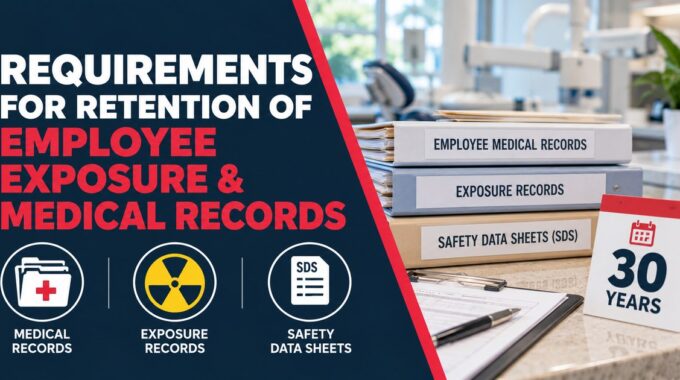
Requirements for Retention of Employee Exposure/Medical Records
Do you know how long your dental practice must keep employee medical and exposure records? Because occupational illnesses may not become apparent for many years, the Federal Occupational Safety and Health Administration (OSHA) requires employers to maintain certain employee medical and exposure records for extended periods. The primary requirements are found in OSHA’s Access to Employee Exposure and Medical Records Standard (29 CFR 1910.1020).
What Records Must Be Kept?
Dental practices may have several types of employee medical and exposure records, including:
- Employee medical records – These may include hepatitis B vaccination records and declinations, post-exposure evaluations and follow-up records, healthcare provider written opinions, and other medical information related to occupational exposures.
- Employee exposure records – These document an employee’s exposure to hazardous agents and may include personal or area exposure monitoring, hazardous chemical monitoring, and x-ray/radiation dosimetry reports.
- Safety Data Sheets (SDSs) – SDSs identifying hazardous chemicals used in the workplace may also be subject to long-term retention requirements. If required exposure records are not available, other records identifying a hazardous agent and where and when it was used may need to be retained.
How Long Must Records Be Kept?
The general retention period under 29 CFR 1910.1020 is:
- Employee medical records: Duration of employment plus 30 years.
- Employee exposure records: 30 years.
- SDSs: Generally 30 years. However, Federal OSHA allows an alternative to keeping the actual SDS for 30 years. An employer may discard an old or discontinued SDS if the employer retains a record for at least 30 years identifying 1) the chemical (name, if known), 2) where it was used, and 3) when it was used.
Employees Have a Right to Their Records
Employees have the right to examine and obtain copies of their employee medical and exposure records. This includes records such as hepatitis B vaccination documentation, post-exposure records, and radiation-monitoring reports.
Under 29 CFR 1910.1020, an employer must provide access within a reasonable time, place, and manner and, if access cannot be provided within 15 working days, must explain the delay and provide the earliest available date. Initial copies must generally be provided at no cost. Former employees retain these access rights.
What Happens When an Employee Leaves?
An employee’s departure does not end the employer’s recordkeeping obligation or the employee’s right to access the records. The practice must continue to maintain records for the applicable retention period.
There is an exception for an employee who worked for the employer for less than one year. Under 29 CFR 1910.1020, the employer generally does not have to retain the medical record for 30 years if the record is provided to the employee upon termination.
What Happens When a Practice Is Sold or Closes?
When a dental practice is sold to a successor employer, applicable employee medical and exposure records must be transferred to the successor and maintained for the required period. If the practice closes without a successor, arrangements must be made to preserve the records and maintain employee access.
Bottom Line
Do not treat employee occupational health records as ordinary personnel files. Keep medical and exposure records confidential, know which records must be retained for 30 years or longer, and make sure records remain accessible even after an employee leaves or the dental practice closes.
Additional Information on Patient Records
For information on access to patient records in California, please refer to our blog post dated October 2025. For detailed information on how to maintain and document patient records, please refer to your liability carrier.
Note: Federal OSHA’s 29 CFR 1910.1020 establishes the basic national requirements for access to and retention of employee exposure and medical records. State OSHA plans may have similar or somewhat different requirements. For example, California’s Title 8 CCR Section 3204, which contains Cal/OSHA’s requirements for retaining employee exposure and medical records, is substantially similar to the Federal Rule. Dental practices should follow the requirements applicable in their state.
Related OSHA Review Resources
- Safety Data Sheets: What Dental Offices Need to Know
- Hepatitis B Vaccination for Potentially Exposed Employees
- Dosimetry Monitoring of Dental X-Ray Equipment
- Dosimetry Monitoring Service
- OSHA Review Compliance Program
About OSHA Review, Inc.
Since 1992, OSHA Review, Inc. has supported dental professionals with regulatory compliance resources, infection control guidance, continuing education, sterilizer monitoring, surface disinfectant products, and dosimetry monitoring services. For more information, visit oshareview.com or call 800-555-6248.

Related Posts