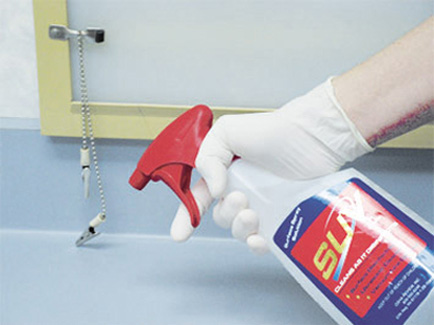
The October 2026 issue of Dental Bytes covers a flu season reminder for dental teams,…
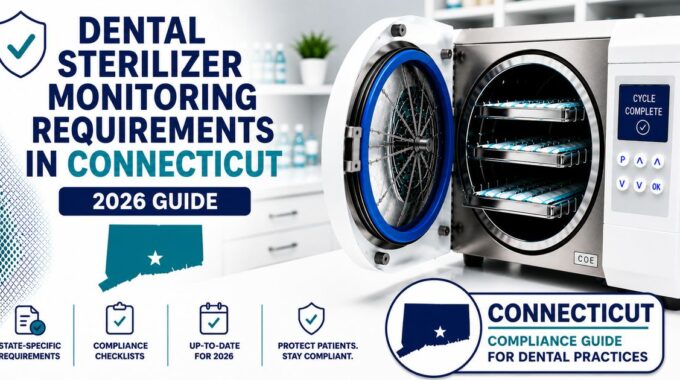
Connecticut Dental Spore Testing Requirements (2026 Guide)
Are Connecticut Dental Offices Required to Perform Spore Testing?
Yes — and Connecticut is one of the few states in this guide where the CDC-compliance standard was written directly into the disciplinary statute itself, by the legislature, rather than adopted through an administrative agency rule. In 2016, the Connecticut General Assembly amended Conn. Gen. Stat. § 20-114, the Dental Commission’s core disciplinary statute, to add subdivision (a)(15): failure to “adhere to the most recent version of the National Centers for Disease Control and Prevention’s guidelines for infection control in dental care settings” is itself listed as a ground for discipline. Because CDC guidance calls for weekly biological (spore) testing of every sterilizer, that’s the standard Connecticut dental offices are held to — and the obligation to follow it sits in the same statute, in the same list, as fraud, incompetence, and cruelty toward patients.
Spore testing is one of three types of sterilization monitoring the CDC recommends — mechanical, chemical, and biological. Each confirms something different about a sterilization cycle.
That’s a structurally different approach from most states in this guide, where CDC compliance is required by an administrative board rule that then connects to discipline indirectly through a general negligence or unprofessional-conduct standard. In Connecticut, the legislature itself made CDC-guideline compliance a named, freestanding disciplinary ground.
This guide covers what § 20-114(a)(15) requires, what to do if a spore test fails, and how Connecticut’s OSHA plan structure — state-run for government workers, federal for everyone else — applies to dental practices.
Connecticut Dental Spore Testing Requirements at a Glance
| Requirement | Connecticut Standard |
|---|---|
| Spore testing requirement | Biological (spore) testing per CDC guidelines — no numeric interval stated directly in the statute itself |
| Governing statute | Conn. Gen. Stat. § 20-114(a)(15) — failure to adhere to current CDC dental infection control guidelines is a named disciplinary ground |
| Regulating body | Connecticut State Dental Commission, Department of Public Health |
| Added to statute | 2016 legislative session — CDC-compliance ground added directly to the discipline statute |
| Additional discipline grounds | § 20-114(a)(2) incompetence or negligent conduct toward patients; § 20-114(a)(5) violating any Board regulation |
| State OSHA plan | Public-employer-only (CONN-OSHA) — private dental practices fall under federal OSHA |
| Enforcement agencies | Connecticut State Dental Commission + federal OSHA (private practices) |
The Connecticut Regulatory Framework for Dental Spore Testing
§ 20-114(a)(15) — CDC Compliance Written Directly Into the Discipline Statute
Most states in this guide reach CDC compliance through an administrative rule that cites a general negligence or sanitation-violation statute. Connecticut skipped that intermediate step: the 2016 legislature amended the Dental Commission’s own disciplinary statute to add failure to follow current CDC infection control guidelines as its own numbered ground for discipline, alongside fraud, incompetence, and unlicensed practice. Because CDC guidance calls for weekly biological spore testing, that’s the practical standard Connecticut dental offices are held to — with the enforcement mechanism built directly into the same statute that authorizes license suspension and revocation.
Backed by the General Negligence Standard
Section 20-114(a)(2) separately makes “incompetence or negligent conduct toward patients” a disciplinary ground, and Connecticut courts have held that this language is equivalent to alleging a practitioner fell below the standard of care. A documented pattern of skipped or undocumented spore testing could be reached under either the CDC-specific ground or this general negligence standard.
A Public-Employer-Only State OSHA Plan
Connecticut operates CONN-OSHA, an OSHA-approved state plan — but unlike most state-plan states, CONN-OSHA covers only state and local government workers. Private dental practices, which make up the overwhelming majority of Connecticut dental offices, remain under federal OSHA jurisdiction for workplace safety requirements including the Bloodborne Pathogens Standard. That’s a third structural pattern in this guide, distinct from both full state-plan states (like Nevada or Oregon) and no-state-plan states (like Alabama or Missouri).
What Connecticut Dental Offices Must Do
1. Test Every Sterilizer Weekly Per CDC Guidance
Run a biological spore test on every sterilizer at least weekly, consistent with the CDC guidelines § 20-114(a)(15) requires dental offices to follow.
2. Document Every Test
Keep dated records of every spore test and its result — the documentation that demonstrates adherence to the CDC guidelines the statute names directly.
3. Stay Current on CDC Guideline Updates
Because § 20-114(a)(15) requires adherence to the “most recent version” of CDC guidance, monitor for CDC updates rather than treating compliance as a one-time standard.
4. Extend CDC Practices Beyond Testing
Follow the full range of CDC infection control recommendations, not just biological monitoring, since the statute references CDC guidelines as a whole.
5. Layer in Mechanical and Chemical Indicators
Use a chemical indicator inside every instrument package and monitor time, temperature, and pressure for every load.
6. Maintain Bloodborne Pathogens Compliance for Federal OSHA
Keep exposure control plans and Bloodborne Pathogens training current, since federal OSHA — not CONN-OSHA — covers private dental practices.
What to Do If a Spore Test Fails in Connecticut
- Remove the sterilizer from service immediately
- Review loading technique, indicator expiration, and cycle settings for cause
- Retest, or have the unit serviced and retested, before returning it to use
- Document the failure, the corrective action, and the retest result — this record is what demonstrates compliance with § 20-114(a)(15)’s CDC-adherence standard
For a full step-by-step protocol, see our guide: What Happens If Your Spore Test Fails?
Who Enforces Spore Testing Requirements in Connecticut?
1. Connecticut State Dental Commission
Administers § 20-114 and can pursue discipline under subdivision (a)(15) for failing to adhere to current CDC infection control guidelines, or subdivision (a)(2) for incompetence or negligent conduct toward patients.
2. Federal OSHA
Enforces the Bloodborne Pathogens Standard and related workplace safety requirements for private dental practices, since CONN-OSHA’s state plan covers only government employers.
Connecticut Spore Testing Compliance Checklist
✅ Weekly biological spore testing performed on every sterilizer
✅ Matching control indicator run from the same lot
✅ Chemical indicator used inside every instrument package
✅ Mechanical monitoring (time/temperature/pressure) recorded for every load
✅ Dated spore testing log maintained
✅ Current CDC infection control guidelines followed and monitored for updates
✅ Bloodborne Pathogens Standard compliance maintained for federal OSHA
How Often Should Connecticut Dental Offices Test?
Section 20-114(a)(15) doesn’t state a numeric interval directly — it requires adherence to whatever the CDC’s most recent guidelines call for. Because CDC guidance recommends weekly biological spore testing, that’s the practical benchmark Connecticut dental offices should meet, with the added requirement of tracking CDC updates over time.
For a full breakdown of testing frequency best practices, see: How Often Do Dental Offices Need Spore Testing?
Frequently Asked Questions: Connecticut Dental Spore Testing
Does Connecticut law require weekly biological spore testing?
Not by a specific number written into the statute. Conn. Gen. Stat. § 20-114(a)(15) requires adherence to the CDC’s most recent infection control guidelines, and weekly biological spore testing is what those guidelines currently call for.
How is Connecticut’s approach different from other states?
Connecticut’s legislature added CDC-guideline compliance directly to the Dental Commission’s disciplinary statute in 2016, making it a named, freestanding ground for discipline rather than a standard reached indirectly through an administrative rule and a general negligence provision.
What happens if a Connecticut dental office doesn’t perform spore testing?
Failing to test can support discipline under § 20-114(a)(15) for failing to adhere to CDC infection control guidelines, or under § 20-114(a)(2) for incompetence or negligent conduct toward patients.
Does Connecticut have its own OSHA program?
Only for government employers. CONN-OSHA is an OSHA-approved state plan limited to state and local government workers; private dental practices fall under federal OSHA jurisdiction.
Is infection control a continuing education requirement in Connecticut too?
Yes, separately from the discipline statute, Connecticut requires dentists and dental hygienists to complete infection control continuing education as part of license renewal — a distinct requirement layered on top of the CDC-adherence discipline ground.
Stay Compliant with the Spore Check System
The Spore Check System from OSHA Review makes it simple to meet the CDC-adherence standard behind Conn. Gen. Stat. § 20-114(a)(15), with full documentation ready if the Dental Commission or federal OSHA ever asks. Our service includes:
✔ Pre-labeled biological indicators mailed directly to your practice
✔ Easy return shipping with prepaid envelopes
✔ Results returned within 24–48 hours
✔ Digital records retained and organized for Commission and OSHA review
✔ Documentation support built to demonstrate CDC-guideline compliance
👉 Learn more about the Spore Check System
Regulatory Sources
- Conn. Gen. Stat. § 20-114 — Disciplinary action by Dental Commission: law.justia.com
- Connecticut State Dental Commission: portal.ct.gov
- CONN-OSHA — Connecticut Department of Labor: portal.ct.gov
- Federal OSHA — Connecticut private-sector enforcement: osha.gov
- CDC — Guidelines for Infection Control in Dental Health-Care Settings—2003: cdc.gov
See also: Dental Sterilizer Monitoring Requirements by State

Related Posts