Do you know how long your dental practice must keep employee medical and exposure records?…
Pregnant Dental Staff and X-Rays: Declared Pregnancy and Fetal Dosimetry Badges
When a dental assistant or hygienist learns she’s pregnant, one of the first questions is usually about X-rays: is it still safe to take them? The short answer is that dental X-ray work can generally continue during pregnancy with the right protections in place. For the practice, that means understanding what it means to “declare” a pregnancy, what dose limit applies and how a fetal dosimetry badge documents that the limit is being met.
This guide covers the rules and the practical steps, so your office is ready before the question comes up. It’s general compliance information, not medical advice. Any employee with concerns about her pregnancy should talk with her own physician.
Can a Pregnant Dental Assistant Take X-Rays?
In most cases, yes. Radiation protection rules don’t prohibit a pregnant employee from working with X-ray equipment. Instead, they set a lower dose limit for the embryo/fetus once the employee chooses to declare her pregnancy, and they make the employer responsible for keeping exposure below it.
In a dental office where staff follow standard X-ray safety practices (operating from behind a barrier or at a safe distance, staying out of the path of the beam, and never holding a sensor or patient in place during an exposure), occupational doses are typically very low. A fetal dosimetry badge lets you confirm that with real numbers instead of assumptions.
What It Means to Declare a Pregnancy
Under the federal radiation protection standard, a declared pregnant woman is one who has voluntarily informed her employer, in writing, of her pregnancy and the estimated date of conception. A few points matter here:
- It’s voluntary. The employee decides whether to declare. The practice can’t require it.
- It must be in writing. A verbal mention isn’t a declaration. The written declaration includes the estimated date of conception.
- It can be withdrawn. According to the NRC’s guidance for workers, Regulatory Guide 8.13, an employee may revoke her declaration, and the lower fetal dose limit then no longer applies.
- Without a declaration, normal limits apply. If an employee chooses not to declare, she’s treated like any other occupationally exposed worker.
Keep the declaration confidential and on file. Federal rules allow it to be stored separately from exposure records.
The Dose Limit During a Declared Pregnancy
Once a pregnancy is declared, 10 CFR 20.1208 limits the dose to the embryo/fetus from occupational exposure to 0.5 rem (5 mSv) for the entire pregnancy. That’s 500 millirem, one-tenth of the 5 rem annual limit for adult radiation workers. The rule also asks employers to avoid substantial variation above a uniform monthly exposure rate, so exposure shouldn’t be concentrated in a few weeks.
When Is a Fetal Badge Required?
Under 10 CFR 20.1502(a)(3), individual monitoring is required for declared pregnant women likely to receive more than 0.1 rem (1 mSv) during the entire pregnancy from sources outside the body.
Many dental employees will never approach that level. But unless you’re monitoring, you can’t show where an employee’s exposure actually stands. That’s why we strongly recommend continuous monitoring for every declared pregnant employee for the full pregnancy. A fetal badge turns “we’re sure it’s fine” into a documented record. It reassures the employee, and it protects the practice if questions come up later.
Where These Rules Come From for Dental Offices
The federal rules above are Nuclear Regulatory Commission (NRC) standards, and the NRC regulates radioactive materials, not X-ray machines. Dental X-ray equipment is regulated by each state’s radiation control program, and many states build the same federal standards into their own rules.
California is a clear example. The state adopts 10 CFR Part 20 by reference in 17 CCR § 30253, replacing the federal term “licensee” with “user.” The state defines a user to include anyone registered as possessing a radiation machine, which covers a dental office’s X-ray units. California dental offices can find more in our guide to California dental dosimetry monitoring.
Requirements differ from state to state, so check your own state’s radiation control rules for the details that apply to your office.
How a Fetal Dosimetry Badge Works
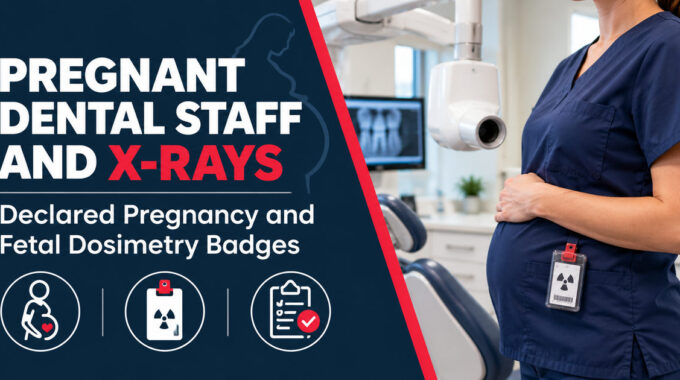
- Where it’s worn. The fetal badge is worn at the waist, in addition to the employee’s regular whole-body badge. If she wears a lead apron, the fetal badge goes under the apron, where it measures what actually reaches the abdomen.
- How often it’s exchanged. Monthly exchange is recommended for fetal badges, so exposure is tracked closely through the pregnancy rather than discovered after the fact.
- Where the results go. Federal rules require the dose to the embryo/fetus to be kept with the declared pregnant woman’s own exposure records (10 CFR 20.2106(e)).
A Checklist for Your Practice
- Have a written declaration form ready, with space for the estimated date of conception, so an employee can declare easily if she chooses to.
- Tell employees the option exists. Include declared pregnancy in your radiation safety training so no one has to ask.
- Order a fetal badge promptly once a declaration is made, and set it for monthly exchange.
- Review each report as it comes in, and keep a running total for the pregnancy.
- Reinforce X-ray safety practices with the whole team: barrier or distance, out of the beam, and no one holds a sensor or patient during an exposure.
- File the records correctly. Keep fetal dose results with the employee’s exposure records, and keep the declaration on file.
A Note on Employment Decisions
Pregnancy isn’t grounds to remove an employee from X-ray duties or change her job on the practice’s own initiative. The decision to declare, and any accommodation she asks for, starts with her. If an employee requests a change in duties, handle it like any other accommodation request, and check with your employment counsel if you’re unsure of your obligations.
OSHA Review’s Dosimetry Monitoring Service
OSHA Review’s Dosimetry Monitoring Service gives dental offices a simple way to document staff X-ray exposure:
- Quarterly or monthly monitoring intervals
- Personnel badges plus an environmental control badge
- A pre-paid return mailer
- Certified lab analysis and an official exposure report
- 24/7 access to results through a secure online portal
- Automatic notification if any badge reading approaches the 300 mrem alert threshold
- Records stored and accessible for compliance review
If a team member declares a pregnancy, contact us to add a fetal badge to your account. Starting monitoring early also gives you a baseline exposure record for your office before a pregnancy ever comes up.
Frequently Asked Questions
Does a pregnant employee have to tell us she’s pregnant?
No. Declaring a pregnancy is voluntary. The lower fetal dose limit applies only after she declares in writing.
What is the radiation dose limit during pregnancy?
For a declared pregnancy, the federal standard limits the dose to the embryo/fetus to 0.5 rem (5 mSv) over the entire pregnancy. Check your state’s rules, since dental X-ray equipment is regulated at the state level.
Where should a fetal badge be worn?
At the waist, in addition to the regular badge, and under the lead apron if one is worn.
Can she stop wearing the fetal badge after her declaration?
She can withdraw her declaration at any time. Once she does, the lower fetal limit no longer applies and she’s monitored like any other employee.

Related Posts