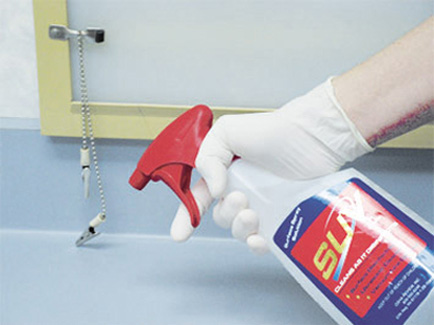
The October 2026 issue of Dental Bytes covers a flu season reminder for dental teams,…
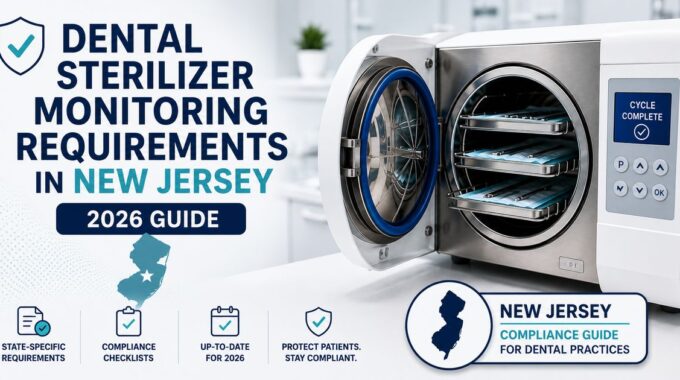
New Jersey Dental Spore Testing Requirements (2026 Guide)
If your dental practice is in New Jersey, weekly spore testing is a compliance requirement—not a suggestion. The New Jersey Board of Dentistry mandates that all licensees follow CDC infection control guidelines under N.J.A.C. 13:30-8.5, and New Jersey’s ambulatory care facility standards under N.J.A.C. 8:43A-14.5 explicitly require biological monitoring of steam sterilizers on a weekly basis.
With approximately 7,000 dental offices across the state, New Jersey has one of the largest dental markets in the country—and the NJ Board of Dentistry and NJ Public Employees’ Occupational Safety and Health (PEOSH) take infection control compliance seriously.
This guide covers everything NJ dental offices need to know: the specific regulations, testing frequency, record-keeping expectations, mandatory continuing education requirements, and what happens if you fall out of compliance.
New Jersey Dental Spore Testing Requirements at a Glance
| Requirement | New Jersey Standard |
|---|---|
| Spore testing frequency (steam sterilizer) | Weekly minimum |
| Spore testing after repair/breakdown | Required before return to service |
| Biological indicator for loads with implantables | Every load; hold until negative result |
| Chemical indicators | Every package processed in steam |
| Infection control CE (dentists) | 2 hours per 2-year renewal period (mandatory) |
| Staff infection control training | At least once per biennial period (required) |
| Primary governing regulation | N.J.A.C. 13:30-8.5; N.J.A.C. 8:43A-14.5 |
The Regulatory Framework: N.J.A.C. 13:30-8.5
The cornerstone of New Jersey’s dental infection control requirements is N.J.A.C. 13:30-8.5, titled “OSHA and CDC requirements.” This section of the New Jersey Board of Dentistry rules mandates that:
Spore testing is one of three types of sterilization monitoring the CDC recommends — mechanical, chemical, and biological. Each confirms something different about a sterilization cycle.
“When providing dental services, all licensees and registrants shall comply with … Centers for Disease Control and Prevention (CDC) Recommended Infection Control Practices for Dentistry, incorporated herein by reference, as amended and supplemented…”
— N.J.A.C. 13:30-8.5(a)(2)
By incorporating CDC guidelines by reference, New Jersey makes the CDC’s Summary of Infection Prevention Practices in Dental Settings legally binding for every licensed dentist and registrant in the state. The CDC specifies that steam sterilizers must undergo biological monitoring (spore testing) at least weekly during normal use, after any repair or breakdown, and with every load containing implantable devices.
The regulation also requires compliance with OSHA 29 CFR 1910.1030 (Bloodborne Pathogens Standard) and the NJ Public Employees’ Occupational Safety and Health (PEOSH) Act, N.J.S.A. 34:6A-25—giving New Jersey two layers of enforcement authority over dental workplace safety.
Ambulatory Care Standards: N.J.A.C. 8:43A-14.5
For dental practices operating as licensed ambulatory care facilities—and for practices that want a clear, codified standard to follow—N.J.A.C. 8:43A-14.5 spells out biological monitoring requirements in explicit, frequency-specific language:
“Biological monitoring with live spores, or an FDA approved equivalent, shall be performed as follows: … Steam sterilizers—weekly;”
— N.J.A.C. 8:43A-14.5(a)(4)
This regulation also requires:
- Peracetic acid sterilizers: Weekly biological monitoring
- Ethylene oxide: Each load
- Low temperature gas plasma: Daily in the working load
- After repair or breakdown: Biological monitoring before return to service
- Loads with implantables: Biological monitor with every load; implantable device shall not be used until a negative biological test result is received
The regulation further requires a chemical indicator or integrator in every package processed in steam, ethylene oxide, or low temperature gas plasma—so mechanical, chemical, and biological monitoring must all be in place simultaneously.
Prevacuum (pre-vac) sterilizers face an additional requirement: a Bowie-Dick air removal test must be performed daily and after any repair or breakdown.
What to Do If a Spore Test Fails
Under N.J.A.C. 8:43A-14.5(b)(4), a positive biological test result triggers an immediate response protocol:
- Remove the sterilizer from service immediately
- Effective corrective action shall be taken, including retesting
- Recall potentially non-sterile items if indicated
- Documentation of all actions taken shall be maintained on site
- An established recall system must be in effect at all times
The requirement to have a recall system in place before you ever need it is significant—it means your office should have a written protocol identifying which patients received instruments processed in that sterilizer during the affected period, and how you would notify them if a recall were necessary.
For more detail on managing a failed spore test, see our guide: What Happens If Your Spore Test Fails?
Mandatory Infection Control CE for New Jersey Dentists
New Jersey requires 40 hours of continuing education per two-year renewal period for licensed dentists. Of those, 10 hours are mandatory and must cover specific topics. Infection control is one of them.
Under N.J.A.C. 13:30-5.1(e)1iii, dentists must complete:
“Two hours of continuing education in preventing and controlling infectious diseases and managing personnel health and safety concerns related to infection control in dental settings. Examples of such education include: modes of disease transmission and the chain of infection; … methods to ensure that patient-care items and environmental surfaces are safe for use; … and evaluation of dental infection control programs.”
Spore testing, sterilization monitoring, and instrument reprocessing protocols fall squarely within the scope of this mandatory 2-hour CE requirement. It must be completed every biennial renewal period—it does not carry over.
Additionally, under N.J.A.C. 13:30-8.5A, licensed dentists must provide or make available infection prevention education and training to all personnel involved in patient-related sterilization, patient care, or maintaining equipment at least once per biennial period. The topics covered must include the same content areas specified in N.J.A.C. 13:30-5.1(e)1iii above.
NJ Dental CE Summary
| Licensee | CE Hours / Biennial Period | Mandatory Infection Control Hours |
|---|---|---|
| Licensed Dentist | 40 hours | 2 hours (mandatory) |
| All sterilization staff | N/A (training provided by dentist) | Biennial in-office training (required) |
New Jersey license renewal is biennial. Check the current renewal date with the NJ Division of Consumer Affairs.
Record-Keeping: What to Document
New Jersey does not specify a single mandatory retention period for spore test records under the dental board rules, but N.J.A.C. 13:30-5.1(c) requires dentists to maintain CE records for two full biennial periods (four years) from the date of completion. Aligning your spore test documentation with this same standard is a reasonable best practice.
For each spore test, document:
- Date of test
- Sterilizer ID or serial number (if you run multiple units)
- Test lot number and expiration date
- Control indicator result
- Test indicator result (pass/fail)
- Name of person who ran the test
- Action taken if result was positive
Under N.J.A.C. 8:43A-14.5(b)(4), documentation of corrective actions following a positive test result must be maintained on site. During any inspection or Board investigation, inspectors will ask for these records.
See also our full guide: Dental Sterilizer Monitoring Requirements by State
Who Enforces Spore Testing Requirements in New Jersey?
New Jersey dental offices face oversight from multiple agencies:
1. NJ State Board of Dentistry
The Board operates under the Division of Consumer Affairs within the Department of Law and Public Safety. It enforces N.J.A.C. 13:30-8.5 and can discipline licensees for failure to comply with CDC infection control guidelines. Violations may result in license suspension, revocation, fines, or mandatory remedial education.
2. NJ Public Employees’ Occupational Safety and Health (PEOSH)
PEOSH enforces workplace safety standards for employees of state and local government entities—which includes many dental clinics operated by county health departments, community health centers, and state agencies. PEOSH operates under the same federal OSHA framework (29 CFR 1910.1030) and can conduct inspections and issue citations.
3. Federal OSHA
Private dental practices fall under federal OSHA jurisdiction for bloodborne pathogen compliance (29 CFR 1910.1030). While OSHA does not directly regulate spore testing frequency, failure to follow CDC guidelines for sterilization monitoring can be cited as a violation of the General Duty Clause.
4. NJ Department of Health
Dental practices licensed as ambulatory care facilities are subject to inspection under N.J.A.C. 8:43A, which includes the explicit weekly spore testing requirement in Section 14.5.
New Jersey Spore Testing Compliance Checklist
Use this checklist to confirm your practice meets NJ requirements:
✅ Steam sterilizer spore tested weekly at minimum
✅ Biological indicator run after any repair or sterilizer breakdown
✅ Every load with implantables receives a biological indicator; implantables quarantined until negative result confirmed
✅ Chemical indicator in every package processed in steam
✅ Pre-vac sterilizer receives daily Bowie-Dick test (if applicable)
✅ Positive test protocol established in writing (corrective action + recall system)
✅ Positive test results and corrective actions documented on site
✅ Spore test records maintained (recommend minimum 4 years)
✅ Dentist completed 2 mandatory hours of infection control CE this biennial period
✅ All sterilization staff received infection prevention training this biennial period
✅ Biological indicator stored per manufacturer specifications
How Often Should NJ Dental Offices Test? A Closer Look
The minimum under NJ/CDC standards is weekly—but many practices and infection control experts recommend more frequent testing, especially if:
- Your sterilizer is high-volume (processing instruments daily for multiple providers)
- You recently had a mechanical or chemical indicator anomaly
- A new staff member has taken over sterilization duties
- Your sterilizer is older or has a service history
Testing more frequently than once a week gives you a smaller window of exposure if a problem is detected later. For a busy NJ dental office processing dozens of packs per day, weekly testing means up to seven days of potentially non-sterile instrument use before a failed test is caught.
For more on testing frequency best practices, see: How Often Do Dental Offices Need Spore Testing?
Frequently Asked Questions: New Jersey Dental Spore Testing
Is weekly spore testing legally required in New Jersey?
Yes. N.J.A.C. 13:30-8.5 requires compliance with CDC infection control guidelines, which mandate weekly biological monitoring of steam sterilizers. N.J.A.C. 8:43A-14.5 explicitly states “Steam sterilizers—weekly” for ambulatory care facilities. Both standards apply to NJ dental practices.
What type of biological indicator is required in New Jersey?
The regulations require biological monitoring “with live spores, or an FDA approved equivalent.” Standard spore test strips, self-contained biological indicators (SCBIs), and rapid readout biological indicators are all acceptable, provided the indicator is appropriate for the sterilization process being used and stored and used per manufacturer instructions.
Do we need to use a mail-in spore testing service, or can we do it in-office?
New Jersey does not require mail-in testing. In-office biological incubators are permitted. However, a third-party spore testing service provides independent documentation and removes the risk of incubator malfunction or handling errors—advantages worth considering in the event of a Board inquiry.
What happens if our spore test fails?
Under N.J.A.C. 8:43A-14.5, you must remove the sterilizer from service, take corrective action, retest, consider a recall of potentially non-sterile items, and document all actions on site. See our full guide: What Happens If Your Spore Test Fails?
Does New Jersey require a specific CE course on infection control?
Yes. N.J.A.C. 13:30-5.1(e)1iii requires 2 mandatory hours of infection control CE per biennial renewal period. The topics must include methods to ensure patient-care items are safe for use—which directly encompasses sterilization monitoring and spore testing protocols.
How long do we need to keep spore test records?
NJ dental board rules do not specify a mandatory retention period for spore test logs specifically, but a minimum of 4 years (two biennial periods) aligns with NJ CE record-keeping standards and is consistent with CDC best practices. Keep failed test records and corrective action documentation on site indefinitely or per your practice’s legal counsel guidance.
Are dental hygienists also required to follow these rules?
Yes. N.J.A.C. 13:30-8.5 applies to “all licensees and registrants,” which includes dental hygienists. The employing dentist is responsible for providing or making available infection control training to hygienists and all sterilization personnel under N.J.A.C. 13:30-8.5A.
Stay Compliant with the Spore Check System
The Spore Check System from OSHA Review is designed to make weekly spore testing simple, reliable, and fully documented for dental practices across New Jersey. Our service includes:
- ✔ Pre-labeled biological indicators mailed directly to your practice
- ✔ Easy return shipping with prepaid envelopes
- ✔ Results returned within 24–48 hours
- ✔ Digital records stored and accessible for inspections
- ✔ Positive result protocol support from our compliance team
👉 Learn more about the Spore Check System
Regulatory Sources
- N.J.A.C. 13:30-8.5 — OSHA and CDC requirements (NJ Board of Dentistry): Full text via Justia
- N.J.A.C. 13:30-8.5A — Infection control education: Full text via Justia
- N.J.A.C. 13:30-5.1 — Continuing dental education requirements (dentists): Full text via Justia
- N.J.A.C. 8:43A-14.5 — Care and use of sterilizers (ambulatory care): Full text via Justia
- CDC — Summary of Infection Prevention Practices in Dental Settings: cdc.gov
- NJ Division of Consumer Affairs — Board of Dentistry: njconsumeraffairs.gov/den

Related Posts