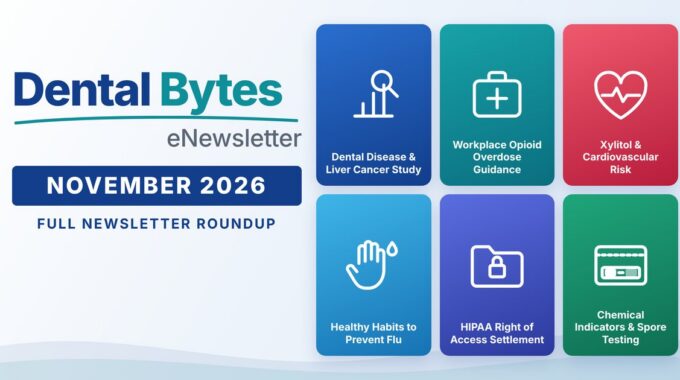
The November 2026 issue of Dental Bytes covers a new study linking dental disease with…
Monitoring Your Dental Sterilizers: Chemical Indicators and Spore Testing
The Dental Board of California is proposing amendments to California’s Infection Control Regulations (Title 16, Section 1005) that would require an internal chemical indicator inside every instrument package undergoing sterilization in a California dental practice. If the internal indicator cannot be seen from outside the package, an external indicator would also be required. Although the amendments have not yet been adopted, the proposal reinforces the importance of chemical monitoring in dental practices.
This post is part of our Dental Bytes eNewsletter 2026 hub, where you can access each monthly issue.
What Are Chemical Indicators?
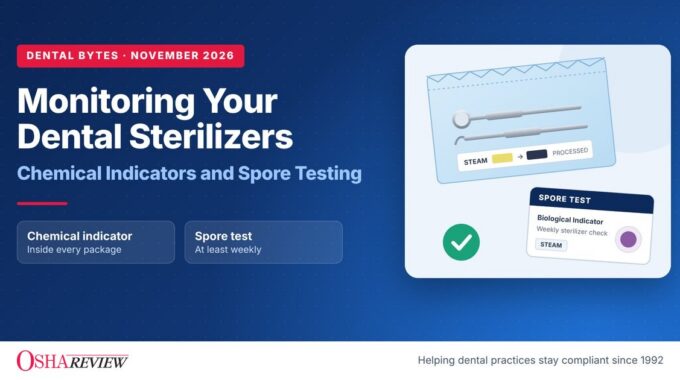
Chemical indicators are designed to show whether certain conditions necessary for sterilization have been achieved. Placed inside instrument packages alongside the instruments, they change color when exposed to specific sterilization conditions. External indicators help distinguish processed packages from those that have not been sterilized.
The US Centers for Disease Control and Prevention (CDC) has recommended using an internal chemical indicator in every package for many years. This is because results can provide an early warning of potential sterilization problems. However, chemical indicators do not prove that instruments are sterile or replace biological monitoring.
Don’t Forget Weekly Spore Testing
Biological monitoring using a spore test remains the gold standard for verifying sterilizer effectiveness. The CDC recommends testing each sterilizer at least weekly using a biological indicator containing highly resistant bacterial spores. Results should be documented and maintained according to applicable requirements.
Chemical and biological indicators serve different purposes: chemical indicators provide immediate feedback about conditions inside individual packages, while spore testing challenges the sterilization process itself.
The Bottom Line
Dental practices should incorporate both chemical and biological monitoring into their instrument sterilization procedures. Using a chemical indicator in every package, along with routine weekly spore testing, provides an additional safeguard to help ensure that instruments are properly processed before patient use.
Related OSHA Review Resources
- Dental Bytes eNewsletter 2026 Hub
- Dental Bytes – November 2026 Newsletter Roundup
- Sterilizer Monitoring in the Dental Office: Are You Using All Three Methods?
- How Often Do Dental Offices Need Spore Testing?
- What Happens If Your Spore Test Fails?
- Dental Sterilizer Monitoring Requirements by State: 2026 Guide
- OSHA Review Spore Check System
- OSHA Review Compliance Program
About OSHA Review, Inc.
Since 1992, OSHA Review, Inc. has supported dental professionals with regulatory compliance resources, infection control guidance, continuing education, sterilizer monitoring, surface disinfectant products, and dosimetry monitoring services. For more information, visit oshareview.com or call 800-555-6248.
This post is part of the Dental Bytes eNewsletter 2026 series. Visit the hub to access all monthly updates.

Related Posts