The October 2026 issue of Dental Bytes covers a flu season reminder for dental teams,…
Florida Dental Spore Testing Requirements (2026 Guide)
Florida Sterilization Monitoring: What the Rule Actually Says
The Florida dental spore testing requirements are unusual. Most states set a weekly interval. Florida instead measures sterilizer use, and it sets two different intervals depending on the type of sterilizer you run.
That means a Florida practice can be fully compliant testing less often than weekly — or badly out of compliance testing weekly — depending on how much the machine actually runs.
The Governing Rule: 64B5-25.003, F.A.C.
Sterilization monitoring for Florida dental offices is set by Rule 64B5-25.003, Florida Administrative Code — Required Sterilization and Disinfection Procedures. The current version took effect May 26, 2025.
Subsection (9) is the provision that matters:
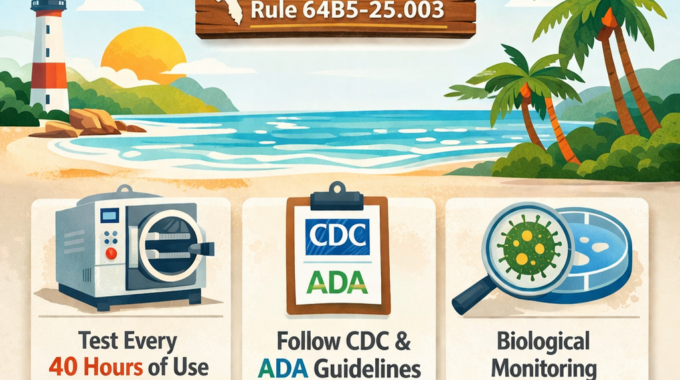
“The procedures and equipment used for sterilization must have their efficacy tested periodically. Adequacy of steam under pressure (e.g. autoclave) or chemical vapor sterilization must have their efficacy verified by appropriate biological monitoring at least once every 40 hours (2400 minutes) of use or at least once every thirty days, whichever comes first. Dry heat and ethylene oxide sterilizers must have their efficacy verified with appropriate biological monitoring every 120 hours of operation at sterilization parameters or every thirty days, whichever comes first. (Use time is determined by multiplying the number of cycles by the individual cycle time.)”
Two tracks, not one
- Steam under pressure (autoclave) or chemical vapor: every 40 hours (2,400 minutes) of use, or every 30 days — whichever comes first.
- Dry heat or ethylene oxide: every 120 hours of operation at sterilization parameters, or every 30 days — whichever comes first.
If your office runs a dry heat unit alongside an autoclave, the two are on different clocks. That is a detail worth checking against your current log.
How to count “use time” — the part most summaries leave out
The rule defines it in a parenthetical that is easy to skip: use time is the number of cycles multiplied by the individual cycle time. It is not how long the machine has been switched on, and it is not elapsed calendar time.
So an autoclave running a 45-minute cycle hits 40 hours at roughly 53 cycles. A practice running eight loads a day reaches that in about seven working days — which is exactly why weekly testing tends to be the right answer in Florida even though the rule never uses the word “weekly.”
Does Florida Require Weekly Spore Testing?
Strictly, no. Practically, for most offices, yes.
The 30-day outer limit is the trap. A practice that tests monthly and reads only that half of the rule will breach the 40-hour limit long before the 30 days are up. The two conditions are joined by “whichever comes first,” so the busier the practice, the less the 30-day figure means.
Weekly testing resolves this without anyone having to track cycle minutes. It is also what the CDC recommends for sterilization monitoring, and it satisfies the Florida interval with margin to spare in all but the highest-volume practices.
Biological monitoring is one of three types of sterilization monitoring. Mechanical and chemical indicators tell you the cycle ran; only the biological indicator tells you it worked.
Florida Adopts the CDC and OSHA Standards by Reference
This is where Florida differs sharply from states that simply write their own rule. Rule 64B5-25.002, F.A.C. (Definitions) formally incorporates two outside documents into Florida dental law:
- The CDC Guideline for Disinfection and Sterilization in Healthcare Facilities, 2008 — incorporated by reference at subsection (4).
- The OSHA bloodborne pathogens standard, 29 C.F.R. § 1910.1030 (2012) — incorporated by reference at subsection (5).
Two consequences follow. First, the incorporated editions are fixed — the 2008 CDC guideline and the 2012 version of the federal standard — so the rule does not automatically track later revisions. Second, because the standards sit inside the Board’s own rule, a bloodborne pathogens failure is a licensure matter in Florida, not only a federal workplace-safety one.
Note also which CDC document Florida chose. It is the 2008 disinfection and sterilization guideline, not the 2003 Guidelines for Infection Control in Dental Health-Care Settings that most state rules point to.
What Else Rule 64B5-25.003 Requires
The monitoring interval sits inside a longer rule. The provisions most likely to come up in an inspection:
- Approved methods only — steam under pressure, dry heat, chemical vapor, or ethylene oxide, and the device must be FDA-approved for sterilization (subsection (1)).
- Sterilize after each use — anything that penetrates soft tissue or bone, and anything that merely contacts oral tissue, including handpieces, slow-speed motors, air polishers, contra-angles and reusable prophy angles (subsections (2)(a), (b), (d)).
- Clean before sterilizing — debris removed by thorough scrubbing or an FDA-approved ultrasonic cleaner or instrument washer (subsection (3)).
- Disposables are single-patient, always — “may never be used on more than one dental patient” (subsection (7)).
- Gloves, masks and protective eyewear during intra-oral procedures, with gloves changed between patients and never washed and reused (subsection (8)).
- OSHA category 2 employees must be provided with and must use the barrier techniques the rule requires (subsection (10)).
Biohazardous waste is handled separately, at Rule 64B5-25.007 in the same chapter.
A sunset clause worth diarising
Subsection (11), added in the 2025 amendment, says the rule “shall be reviewed, and if necessary, repealed, modified, or renewed through the rulemaking process five years from the effective date.” That puts the next review on the calendar for around May 2030. Florida’s monitoring intervals are not permanent fixtures — check the rule rather than relying on a summary written years earlier.
How Florida Enforces It
Rule 64B5-25.003 implements § 466.028, Florida Statutes, the grounds for disciplinary action against dental licensees. Two paragraphs do the work:
- § 466.028(1)(u) — “Failure to provide and maintain reasonable sanitary facilities and conditions.”
- § 466.028(1)(x) — incompetence or negligence in failing to meet minimum standards of performance “when measured against generally prevailing peer performance.”
Section 466.028(2) then routes penalties to § 456.072, Florida Statutes, which is where the consequences are set out:
- An administrative fine of up to $10,000 for each count or separate offense (§ 456.072(2)(d)) — among the higher ceilings in the country.
- Suspension, practice restriction, probation, reprimand, or remedial education (§ 456.072(2)).
- Costs of investigation and prosecution are assessed on top, and the statute says the board “shall” assess them — staff salaries, attorney time and other case expenses (§ 456.072(4)).
- Revocation, if imposed, is permanent (§ 456.072(6)).
Separately, § 456.072(1)(b) makes intentionally violating a board rule its own ground for discipline.
Federal OSHA, Not a State Plan
Florida has no OSHA State Plan. It does not appear on OSHA’s list of approved State Plans, so Florida dental practices are inspected by federal OSHA directly under 29 C.F.R. § 1910.1030.
The wrinkle is the one above: the Board of Dentistry has written that same federal standard into its own rule. A bloodborne pathogens lapse in a Florida dental office can therefore be reached twice — by federal OSHA as an employer, and by the Board as a licensee.
Common Compliance Mistakes in Florida Dental Offices
- Testing monthly and stopping there — ignoring the 40-hour condition that almost always arrives first
- Counting “use” as hours powered on, rather than cycles multiplied by cycle time
- Putting a dry heat unit on the 40-hour schedule, or an autoclave on the 120-hour one
- Monitoring the primary sterilizer only and leaving backup units unlogged
- Logs that record a date and a result but not which sterilizer was tested
- Working from a summary of the rule written before the May 2025 amendment
- Treating the incorporated CDC and OSHA standards as advisory when Florida has made them mandatory
Florida Spore Testing Requirements — Quick Checklist
- Steam or chemical vapor: biological indicator every 40 hours of use or 30 days, whichever first
- Dry heat or ethylene oxide: every 120 hours of operation or 30 days, whichever first
- Track use time as cycles × cycle time, per sterilizer
- Every sterilizer in the office on its own log, backups included
- Documented results, retrievable during an inspection
- Failed test: unit out of service, items recalled and reprocessed, retested, documented
- Bloodborne pathogens obligations met under 29 C.F.R. § 1910.1030 as incorporated by the Board’s rule
If a biological indicator comes back positive, take the sterilizer out of service immediately, reprocess anything sterilized since the last passing test, and keep it out of service until it returns a pass.
How OSHA Review Helps Florida Dental Offices Stay Compliant
OSHA Review’s Spore Check System is weekly mail-in biological monitoring with the recordkeeping built in — which for most Florida practices is the simplest way to stay inside a 40-hour limit without counting cycle minutes.
- Pre-barcoded kits — no lab account to set up
- Laboratory-verified results by email or fax
- Full sterilization history available 24/7 for inspections
- Follow-up reminders if a test is not received within 14 days
- A microbiologist available at no charge if a test comes back positive
See how Florida compares with the rest of the country in our state-by-state sterilizer monitoring guide.
Regulatory Sources
- Rule 64B5-25.003, F.A.C. — Required Sterilization and Disinfection Procedures (effective 5/26/2025)
- Rule 64B5-25.002, F.A.C. — Definitions (CDC and OSHA incorporations)
- Chapter 64B5-25, F.A.C. — Sterilization and Disinfection Procedures
- § 466.028, Fla. Stat. — Grounds for disciplinary action
- § 456.072, Fla. Stat. — Grounds for discipline; penalties; enforcement
- CDC — Best Practices for Sterilization Monitoring
- CDC — Guidelines for Infection Control in Dental Health-Care Settings (2003)
- 29 C.F.R. § 1910.1030 — Bloodborne Pathogens Standard
- OSHA — State Plans
This guide is general compliance information, not legal advice. Verify current requirements with the Florida Board of Dentistry and the Florida Administrative Code.

Related Posts