Do you know how long your dental practice must keep employee medical and exposure records?…
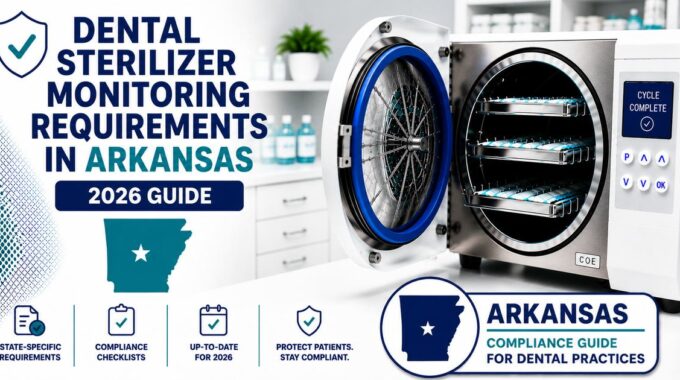
Arkansas Dental Spore Testing Requirements 2026
Arkansas dental practices are required to monitor their sterilizers with biological spore tests as part of the state’s infection control standards. The authority comes from Article XV of the Arkansas State Board of Dental Examiners Rules (Rule 038.00.07-001), which sets out sterilization monitoring requirements for all licensed dental health care personnel in the state. Understanding these requirements—and the specific protocol for a positive test result—is essential for every Arkansas dental office.
Arkansas Sterilization Monitoring Requirements
Under Article XV, Section E(3) of the Arkansas infection control rules, all dental practices must follow a structured sterilization monitoring protocol. The rules are detailed and go beyond basic spore testing to cover load-by-load mechanical and chemical monitoring as well. See how Arkansas compares to other states in the national overview.
Spore testing is one of three types of sterilization monitoring the CDC recommends — mechanical, chemical, and biological. Each confirms something different about a sterilization cycle.
Biological Monitoring (Spore Testing)
Arkansas requires spore testing at a minimum monthly interval—at least once per month by using a biological indicator (spore test) with a matching control. This is notably less frequent than the CDC’s recommended weekly interval, but practices should be aware that CDC guidelines remain the professional standard for quality patient care. Each positive spore test triggers a specific response protocol (detailed below).
Per-Load Monitoring Requirements
Separate from the monthly biological monitoring, Arkansas requires that every sterilization load be monitored with both:
- Mechanical indicators — time, temperature, and pressure readings for each cycle
- Chemical indicators — color change markings on bags or autoclave tape attached to each package
Instrument packs must not be used if mechanical or chemical indicators show inadequate processing. These per-load checks apply to every cycle, every day—not just monthly.
Implantable Devices: What the Rule Says and What the CDC Adds
Arkansas’s rule addresses implantable devices in one line. Article XV, Section E(2)(c) states that implantable devices must not be sterilized unwrapped.
The rule does not set a separate spore testing interval for implants. The CDC goes further: its sterilization monitoring guidance recommends a spore test for every load that contains an implantable device and, ideally, holding the device until the test comes back negative. That is the professional standard an Arkansas practice placing implants should follow, even though the state rule’s own minimum is monthly.
What Happens When a Spore Test Fails
Arkansas’s rules are explicit about the protocol following a positive spore test. When a spore test fails, the required steps under Article XV, Section E(3)(d)-(e) are:
- Remove the sterilizer from service immediately and stop using it
- Retest the sterilizer using a new biological indicator
- If the repeat spore test is negative: return the sterilizer to service
- If the repeat spore test is positive: keep the sterilizer out of service until it has been inspected or repaired, and recall and reprocess all items processed since the last negative test
The recall requirement is significant. A confirmed second positive test means tracking down and reprocessing every instrument sterilized since the last confirmed-good result—potentially affecting multiple days of patient care. This makes reliable, documented spore testing critical to limiting exposure in the event of a failure.
Record-Keeping: Three-Year Retention
Arkansas requires that sterilization records and biological spore testing documentation be maintained for three years. This is longer than many surrounding states and means your records need to cover any inspection or complaint that may surface years after the fact. Your sterilization log should document:
- Date of each sterilization run
- Mechanical indicator readings (time, temperature, pressure)
- Chemical indicator results
- Biological indicator (spore test) results and dates, with controls
- Which sterilizer was used (if the practice has multiple units, per Article XV, Section E(4)(a))
- For any failed spore test: what action was taken, retest results, and any recall actions
Article XV also requires that the sterilizer used be identified on the outside of each instrument package—critical for tracing which loads were processed on which unit if a failure occurs.
Enforcement and Discipline
Arkansas Code § 17-82-316 lists the grounds on which the Arkansas State Board of Dental Examiners may revoke or suspend a license. Subsection (c)(3) names this one directly: failure to maintain proper standards of sanitation, or failure otherwise to maintain adequate safeguards for the health and safety of patients. A practice that does not follow Article XV’s sterilization monitoring requirements is exposed under that ground.
Arkansas does not have a state OSHA plan—federal OSHA enforces the Bloodborne Pathogens Standard (29 CFR 1910.1030) in Arkansas dental offices through the Little Rock Area Office. OSHA covers personal protective equipment, sharps handling, and exposure control, while the Board of Dental Examiners covers sterilization monitoring and infection control standards.
Maintain Compliance with the Spore Check System
Arkansas’s combination of monthly minimum spore testing, per-load mechanical and chemical monitoring, the wrapped-sterilization rule for implantable devices, and three-year record retention creates a layered documentation burden. The Spore Check System helps Arkansas dental offices track every biological indicator test, document per-load results, and maintain the organized records needed if the Board ever requests a review—or if a failed spore test triggers the recall protocol.
Arkansas’s rules are clear: monthly spore tests at minimum, every load gets mechanical and chemical checks, implantable devices are never sterilized unwrapped, and all records are kept for three years. A consistent system protects your patients and your license.
Regulatory Sources
- Arkansas State Board of Dental Examiners, Article XV: Infection Control (Rule 038.00.07-001)
- Arkansas Code § 17-82-316: Revocation or suspension, grounds
- Arkansas State Board of Dental Examiners (Arkansas Department of Health)
- CDC Guidelines for Infection Control in Dental Health-Care Settings, 2003
- CDC: Sterilization monitoring best practices
- OSHA Bloodborne Pathogens Standard, 29 CFR 1910.1030
- OSHA State Plans

Related Posts