Do you know how long your dental practice must keep employee medical and exposure records?…
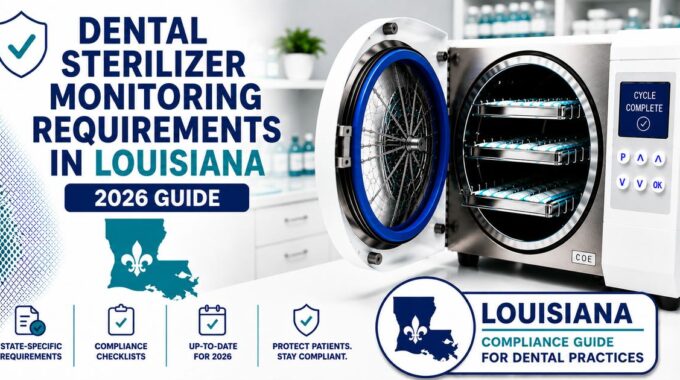
Louisiana Dental Spore Testing Requirements 2026
Louisiana dental practices must run biological spore tests on every autoclave to verify sterilization. The requirement comes directly from the Louisiana State Board of Dentistry under Louisiana Administrative Code Title 46, Part XXXIII, Chapter 12, §XXXIII-1206, which mandates that each sterilizer be monitored in accordance with dental sterilizer monitoring requirements by state—including designations the CDC marks as “strongly recommended.” Failing to follow these standards puts patients at risk and exposes the practice to Board discipline.
What Louisiana Law Requires
Under LAC 46:XXXIII-1206, every dentist in Louisiana must:
Spore testing is one of three types of sterilization monitoring the CDC recommends — mechanical, chemical, and biological. Each confirms something different about a sterilization cycle.
- Monitor each sterilizer per CDC guidelines — The CDC’s dental infection control guidelines call for weekly biological indicator (spore) testing. Louisiana’s rule incorporates those guidelines by reference, meaning the CDC’s weekly standard is Louisiana’s legal standard.
- Maintain a written log for every test that includes: the date of the test, the monitoring method used, the manufacturer and type of monitoring system, and the name of the individual who performed the monitoring.
- Retain all sterilization records for two years from the date of the last test.
- Keep purchase documentation — Records must include documentation for the purchase of testing materials or kits, as well as written reports of each test conducted.
The Board may request sterilization records from randomly selected licensees as part of its inspection authority under LAC 46:XXXIII.1204. Practices should treat their spore testing logs as ready for review at any time.
CDC Baseline: Weekly Spore Testing
Because Louisiana adopts CDC guidelines by reference, understanding how often dental offices need spore testing under CDC standards is essential. The CDC’s Guidelines for Infection Control in Dental Health-Care Settings (2003) call for:
- Biological indicator (spore) testing at least weekly for heat sterilizers
- Mechanical and chemical indicators for every sterilization load
- Immediate removal from service and retesting if a spore test returns positive
- For implantable devices: a biological indicator with every load, and verification before use
Louisiana’s rule explicitly covers sterilization designations that the CDC lists as “strongly recommended”—so there is no ambiguity about whether those standards apply. They do.
What Happens If a Spore Test Fails
A positive spore test means the sterilizer is not reliably killing bacterial endospores. What happens if your spore test fails depends on how quickly and thoroughly you respond. The standard protocol under CDC guidelines is:
- Remove the sterilizer from service immediately
- Retest using a new biological indicator
- Do not return the unit to service until you get a negative result
- Review all items processed since the last confirmed negative test
- Document every step in your sterilization log
Ignoring a failed spore test or continuing to use a malfunctioning sterilizer is a direct violation of LAC 46:XXXIII-1206 and CDC guidelines—both of which the Louisiana Board enforces.
OSHA and Federal Oversight in Louisiana
Louisiana does not have a state OSHA plan. Federal OSHA—through the Baton Rouge Area Office—enforces the Bloodborne Pathogens Standard (29 CFR 1910.1030) in Louisiana dental offices. That standard requires engineering controls, personal protective equipment, and safe handling of contaminated instruments, but it does not set a specific spore testing interval. The spore testing requirement comes from the Louisiana Board of Dentistry through its incorporation of CDC guidelines, not from OSHA directly.
This means Louisiana dental practices operate under dual oversight: the Louisiana State Board of Dentistry for infection control standards (including spore testing) and federal OSHA for bloodborne pathogen compliance.
Record-Keeping Requirements
Louisiana’s two-year retention rule is among the more straightforward in the region. Your sterilization records must include:
- Test date and method
- Monitoring system manufacturer and type
- Name of the person who performed the test
- Purchase receipts or invoices for biological indicator test kits
- Written reports of results for each test cycle
Keep these records organized and accessible. The Board’s authority to request records from randomly selected licensees means you may be asked to produce them without advance notice of a complaint or investigation.
Simplify Compliance with the Spore Check System
Keeping up with weekly testing, maintaining a compliant log, and storing purchase documentation for two years is manageable—but only if your system is reliable. The Spore Check System is designed to help Louisiana dental offices run tests on schedule, document results automatically, and stay ready for Board review without extra administrative burden.
Louisiana’s rule is clear: monitor every sterilizer per CDC guidelines, log every test, keep records for two years. The practices that stay compliant are the ones with a consistent system in place.
Regulatory Sources
- LAC 46:XXXIII.1206: Sterilizer Monitoring Log and Record Retention
- LAC 46:XXXIII.1204: Investigations
- Louisiana State Board of Dentistry: Laws and Rules
- CDC Guidelines for Infection Control in Dental Health-Care Settings, 2003
- CDC: Sterilization monitoring best practices
- OSHA Bloodborne Pathogens Standard, 29 CFR 1910.1030
- OSHA State Plans

Related Posts