The October 2026 issue of Dental Bytes covers a flu season reminder for dental teams,…
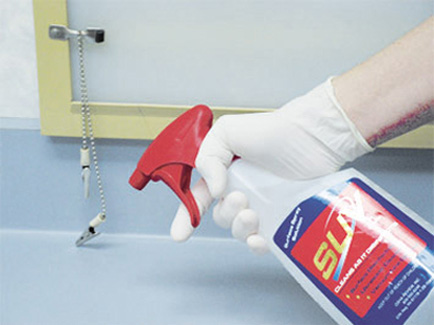
What Does Surface Disinfection Really Cost Per Operatory?
Surface disinfectant is one of those supplies nobody budgets for. It shows up on every supply order, it gets used after every patient, and it rarely gets a second look. But across a year, and across every operatory in the practice, dental disinfectant cost adds up to real money, and most practices have never actually added it up.
Here is how to work out what surface disinfection costs your practice per operatory, what drives that number, and where the savings are.
Why the Cost Adds Up Faster Than You Think
The CDC’s infection control recommendations for dental settings call for cleaning and disinfecting clinical contact surfaces that aren’t barrier-protected after each patient, using an EPA-registered hospital disinfectant. That means every chair, light handle, counter and switch gets sprayed and wiped, often twice (once to clean, once to disinfect), between every patient in every room.
Multiply that by eight to twelve patients a day per operatory, five days a week, and a product that costs a few dollars a bottle becomes a line item worth thousands of dollars a year.
What Drives Your Disinfectant Cost
1. Price per usable gallon
This is the biggest factor, and the one most practices never calculate. Ready-to-use sprays are priced by the bottle or the gallon, and you pay for every ounce of water in them. A concentrate is mixed with water in the office, so the price that matters is what one gallon costs after mixing. At prices we checked in 2026, popular ready-to-use dental disinfectants ran roughly $25 to $47 per gallon. A concentrate mixed at 2 ounces per gallon can come in under $4 per gallon.
2. How much you use per room turnover
Following the label means using enough product to keep the surface visibly wet for the full contact time. Under-spraying doesn’t save money. It just means the surface wasn’t disinfected. (Our guide to disinfectant contact time explains why.) So the realistic way to cut cost is to lower the price per gallon, not the amount used.
3. Spray vs. pre-saturated wipes
Wipes are convenient, but you pay for that convenience in every canister. They can also dry out once opened, and a single wipe often isn’t enough to keep a large surface wet for the full contact time, so offices end up using several per surface. Spray-and-wipe with a mixed concentrate is usually the lower-cost way to cover the same area.
4. Shipping and storage
A ready-to-use gallon is mostly water, and you pay to ship it and find shelf space for it. A single quart of concentrate that makes 16 gallons takes up a fraction of the room and weighs a fraction as much.
5. How many products you buy
Many offices buy one product for surfaces, another for the ultrasonic cleaner and a third for vacuum lines. A product that is labeled for more than one of those jobs replaces several line items on the supply order.
A Worked Example: A Four-Operatory Practice
Let’s put numbers on it. Assume a four-operatory practice uses about two gallons of surface disinfectant per operatory per month. That works out to roughly 96 gallons a year across the practice.
| Product type | Cost per gallon | Annual cost (96 gallons) | Per operatory per year |
|---|---|---|---|
| Premium ready-to-use spray | $46.55 | $4,469 | $1,117 |
| Mid-priced ready-to-use spray | $25.35 | $2,434 | $608 |
| SUV Ultra 5 concentrate (2 oz/gallon) | $3.44 | $330 | $83 |
In this example, switching from a premium ready-to-use spray to a concentrate saves more than $4,000 a year, or about $1,000 per operatory. Even against a mid-priced spray, the savings are over $2,000 a year. Your numbers will depend on your patient volume and what you use today, which is why we built a calculator to run them for you.
Cost Is Only Half the Decision
A cheaper disinfectant is no bargain if it doesn’t do the job. Before you switch products, check that the new one:
- Is EPA-registered as a hospital disinfectant, as the CDC recommends for clinical contact surfaces
- Carries label claims against the organisms that matter in dentistry, including bloodborne pathogens
- Has a contact time your team can realistically follow between patients
- Is compatible with the surfaces and equipment in your operatories
For more on choosing a product, see our guide to surface disinfection in dental settings.
How SUV Ultra 5 Changes the Math
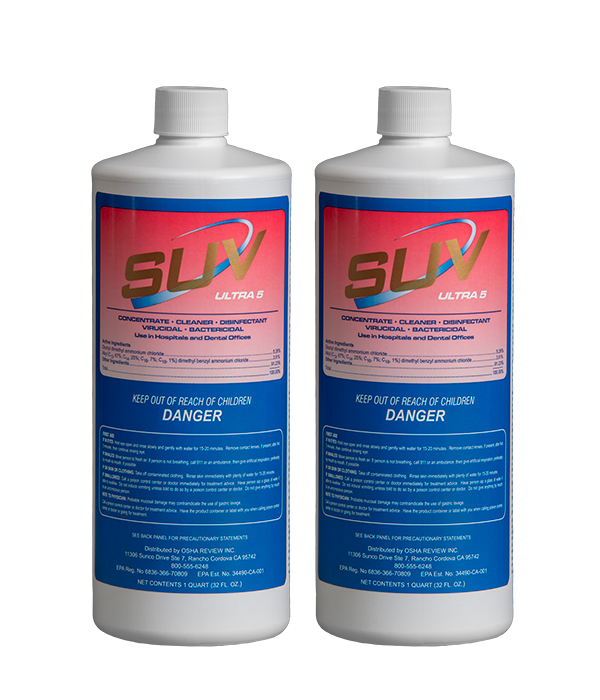
SUV Ultra 5 Disinfectant & Cleaner from OSHA Review is a concentrate built for dental practices:
- One quart of concentrate makes 16 gallons of ready-to-use disinfectant
- A hospital-grade disinfectant proven effective against HIV, HBV and HCV
- Three uses in one product: surface disinfectant, ultrasonic cleaning solution and vacuum line cleaner
- Colorless, fragrance-free and neutral pH, with no alcohol, ammonia, bleach, iodine or peroxide
- Spray bottles and mixing containers included free with concentrate orders
Calculate Your Practice’s Savings
Want to see your own numbers? Our free SUV Ultra 5 Cost Calculator asks three quick questions (how many operatories you have, what you use now and roughly what you spend) and shows your estimated annual savings in under a minute. It also estimates the extra savings from using SUV Ultra 5 in your ultrasonic cleaner and vacuum lines.
Frequently Asked Questions
How much disinfectant does a dental operatory use?
It depends on patient volume and how surfaces are covered, but a busy operatory can easily use a gallon or more a month. Using enough to keep surfaces wet for the full label contact time matters more than trying to use less.
Is a concentrate as effective as a ready-to-use spray?
Yes, when it is mixed at the dilution on its EPA-registered label. The label, not the format, determines what the product kills and how long it needs to stay wet. Mix fresh solution as the label directs and use the measuring tools provided.
Are disinfectant wipes cheaper than spray?
Usually not. Wipes cost more per use and can take several per surface to keep the area wet for the full contact time. Spray-and-wipe with a mixed concentrate typically covers the same surfaces for less.

Related Posts