Do you know how long your dental practice must keep employee medical and exposure records?…
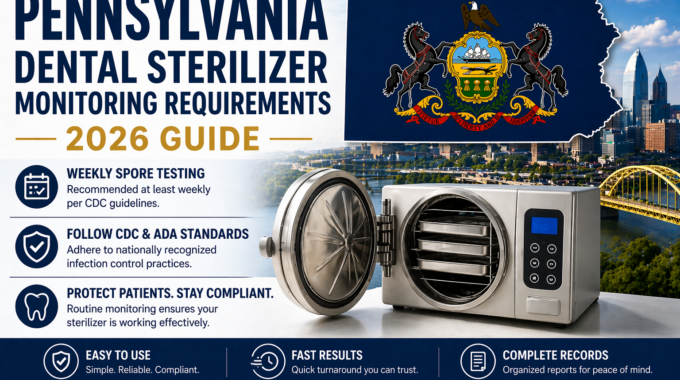
Pennsylvania Dental Spore Testing Requirements
What Pennsylvania Actually Requires — and Where the Requirement Lives
The Pennsylvania dental spore testing requirements are often described as vague. They are not. The State Board of Dentistry’s unprofessional conduct rule makes it a disciplinary offense to fail to follow the CDC’s current infection control recommendations — by name — and it puts the dentist on the hook for making sure the staff follow them too.
What the rule does not do is state a testing interval in its own words. It borrows the CDC’s, and the CDC’s is weekly.
The Governing Rule: 49 Pa. Code § 33.211(a)(7)
Section 33.211 defines unprofessional conduct for dentists, hygienists and expanded function dental assistants. For dentists, paragraph (a)(7) reads:
“Failing to follow current infection-control recommendations issued by the Federal Centers for Disease Control or to ensure that auxiliary personnel and other supervisees follow these Federal guidelines.”
Two duties sit in that sentence:
- Follow current CDC recommendations. “Current” means no fixed edition. When the CDC updates its guidance, Pennsylvania’s standard moves with it, without any new rulemaking.
- Make sure your team follows them. A dentist can be disciplined for an assistant’s missed spore test, not just their own.
The same rule applies the CDC duty to dental hygienists (§ 33.211(b)(4)) and expanded function dental assistants (§ 33.211(c)(4)) in their own right. And paragraph (a)(2) separately makes “failing to carry out supervisory responsibility with regard to auxiliary personnel” unprofessional conduct.
So how often is spore testing required in Pennsylvania?
Because the rule adopts the CDC’s current recommendations, the interval is the CDC’s: at least weekly biological monitoring of every sterilizer. That comes from the CDC’s Guidelines for Infection Control in Dental Health-Care Settings, the CDC’s best practices for sterilization monitoring, and the CDC’s Summary of Infection Prevention Practices in Dental Settings.
Biological monitoring is one of three types of sterilization monitoring. Mechanical and chemical indicators show the cycle ran; only the biological indicator shows it killed resistant spores. Test weekly, per sterilizer, including backup units, and after any repair.
How It Is Enforced
Section 33.211 defines unprofessional conduct as that term is used in section 4.1(a)(8) of the Dental Law (63 P.S. § 123.1(a)(8)), which lets the Board refuse, suspend or revoke a license for unprofessional conduct. The statute defines that to include “any departure from, or failure to conform to, the standards of acceptable and prevailing dental … practice,” and says “actual injury to the patient need not be established.” A missed spore test is a violation whether or not anyone was harmed.
Beyond license action, the Board’s options under the Dental Law include public reprimand, probation, required education and restitution to patients. On top of that, Pennsylvania’s professional licensing statute, 63 Pa.C.S. § 3108(b), gives every licensing board, including Dentistry, the power to:
- levy a civil penalty of up to $10,000 per violation of its licensing act or regulations (§ 3108(b)(4)), and
- charge the licensee the costs of the investigation behind the disciplinary action (§ 3108(b)(5)).
Because the penalty is counted per violation, several findings in one case — an untested sterilizer, missing logs, staff not following protocol — can each carry their own penalty.
Records: Five Years for Patients, No Stated Period for Sterilization
49 Pa. Code § 33.209(b) requires patient dental records to be kept for at least five years from the last dental entry. Pennsylvania sets no specific retention period for sterilization or biological monitoring logs.
Our suggestion: keep sterilization logs at least five years, matching patient records. If a patient complaint surfaces, the log is how you show the instruments used on that patient came out of a sterilizer that was passing its weekly tests.
Federal OSHA Covers Pennsylvania Practices
Pennsylvania has no OSHA State Plan — it does not appear among the plans on OSHA’s State Plans page. Pennsylvania dental practices are inspected by federal OSHA under the bloodborne pathogens standard, 29 C.F.R. § 1910.1030.
The two regimes reach the same conduct from different directions. Federal OSHA protects employees; § 33.211(a)(7) protects patients through CDC guidance that covers much of the same ground. One lapse can be a federal OSHA matter for the employer and a licensure matter for the dentist.
What to Document
Pennsylvania’s rule makes you responsible for your staff’s compliance, so the log should show who did what. Capture:
- Date of each biological indicator test
- Which sterilizer was tested, identified specifically
- Cycle type and parameters
- Result — pass or fail
- Who ran the test
- Corrective action after any failure, and the confirming pass that returned the unit to service
- Maintenance and repair records
If a Spore Test Fails
If a biological indicator comes back positive:
- Take the sterilizer out of service immediately.
- Recall and reprocess everything sterilized since the last passing test.
- Retest, checking operator technique and loading first — procedural error is the most common cause.
- If the retest also fails, keep the unit out of service until it is inspected, repaired, and returns a pass.
- Document every step, including the failure. That record is what shows current CDC recommendations were followed.
Pennsylvania Compared with Its Neighbours
- Ohio writes weekly testing, a control, and two years of on-site records into its own rule.
- New Jersey writes weekly testing into its own regulations.
- New York requires “scientifically accepted” sterilization techniques without naming the CDC.
- Maryland names biological spore testing in its rule and requires a supervising dentist in every office.
Pennsylvania sits in the middle: no interval of its own, but a direct, dynamic reference to the CDC — the same approach Georgia takes — plus explicit responsibility for staff.
Common Compliance Mistakes in Pennsylvania Dental Offices
- Believing Pennsylvania has no infection control rule — § 33.211(a)(7) names the CDC directly
- Working from an older CDC document when the rule says current recommendations
- Assuming a staff member’s missed test is the staff member’s problem alone
- Monitoring the primary sterilizer only and leaving backups untested
- Discarding sterilization logs sooner than patient records
- Returning a sterilizer to service after a failure without a documented passing retest
Pennsylvania Spore Testing Requirements — Quick Checklist
- Weekly biological indicator test on every sterilizer, per current CDC recommendations
- Staff trained and supervised so they follow CDC guidance — the dentist is responsible
- Patient records kept at least five years; sterilization logs kept at least as long
- Failed spore test: unit out of service, items recalled, retested, documented
- Bloodborne pathogens obligations met under 29 C.F.R. § 1910.1030 (federal OSHA)
How OSHA Review Helps Pennsylvania Dental Offices Stay Compliant
OSHA Review’s Spore Check System is weekly mail-in biological monitoring with the recordkeeping handled for you — an independent record that your sterilizers passed, week after week, whoever on your team ran the test. The system is endorsed by multiple state dental associations.
- Pre-barcoded kits — no lab account to set up
- Laboratory-verified results by email or fax
- Full sterilization history available 24/7 for inspections
- Follow-up reminders if a test is not received within 14 days
- A microbiologist available at no charge if a test comes back positive
See how Pennsylvania compares with the rest of the country in our state-by-state sterilizer monitoring guide.
Regulatory Sources
- 49 Pa. Code § 33.211 — Unprofessional conduct ((a)(7) CDC infection control; (b)(4) hygienists; (c)(4) EFDAs)
- 49 Pa. Code § 33.209 — Patient records
- 63 Pa.C.S. § 3108 — Civil penalties
- Pennsylvania State Board of Dentistry
- CDC — Guidelines for Infection Control in Dental Health-Care Settings (2003)
- CDC — Summary of Infection Prevention Practices in Dental Settings
- CDC — Best Practices for Sterilization Monitoring
- 29 C.F.R. § 1910.1030 — Bloodborne Pathogens Standard
- OSHA — State Plans
This guide is general compliance information, not legal advice. Because § 33.211(a)(7) adopts the CDC’s current recommendations, verify the latest CDC guidance and the Board’s rules before relying on any summary, including this one.

Related Posts