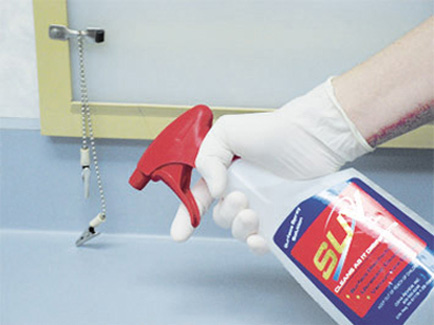
The October 2026 issue of Dental Bytes covers a flu season reminder for dental teams,…
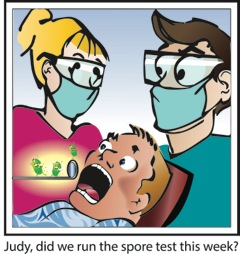
Texas Dental Spore Testing Requirements (2026)
What Texas Actually Requires — and Where the Requirement Lives
The Texas dental spore testing requirements come from a State Board of Dental Examiners rule that says, in so many words, that sterilizers must be tested. What it does not do is set the interval itself. Instead it hands that question to the American Dental Association — and the ADA’s answer, following the CDC, is weekly.
The Governing Rule: 22 Tex. Admin. Code § 108.24
Section 108.24, Required Sterilization and Disinfection, sits in the Board’s Sanitation and Infection Control subchapter. Subsection (b) lists the approved sterilization methods — steam autoclave, chemical vapor, dry heat, ethylene oxide, or a chemical sterilant used according to the manufacturer — and then says:
“Sterilization equipment and its adequacy shall be tested and verified in accord with American Dental Association (ADA) recommendations.”
That is a mandatory testing duty, written into Texas’s own rule. The interval comes from the ADA, whose infection control guidance states that “the CDC recommends monitoring sterilizers at least weekly with biological indicators.”
So how often is spore testing required in Texas?
At least weekly, for every sterilizer. Texas’s rule points to the ADA; the ADA points to the CDC’s Guidelines for Infection Control in Dental Health-Care Settings and best practices for sterilization monitoring. Because the rule adopts the ADA’s recommendations without naming an edition, if that guidance changes, the Texas standard changes with it.
Biological monitoring is one of three types of sterilization monitoring. Mechanical and chemical indicators show the cycle ran; only the biological indicator shows it killed resistant spores. Test weekly, per sterilizer, including backup units, and after any repair.
The rest of § 108.24
- (a): sterilization is required for all surgical and other instruments used invasively or in contact with soft tissue or bone. Non-surgical instruments that touch tissue must be disinfected with a tuberculocidal solution.
- (c): after a procedure, contaminated instruments and operatory equipment must be at least disinfected, and preferably sterilized, by a CDC- or ADA-approved method before reuse.
- (d): instruments must be free of visible debris before sterilization — scrubbed with detergent and water or run through an ultrasonic cleaner.
- (f): disposable items are never used on more than one patient.
- (g)–(i): contaminated items are biohazardous; extracted teeth and lab cases must be rendered non-biohazardous before they leave the office or return from the lab.
The Surrounding Rules
- § 108.21 requires the entire dental office to be kept “in a clean and sanitary condition” and requires the dentist to “use properly sterilized instruments.”
- § 108.22 requires a dentist, on demand by Board staff acting on a sanitation complaint, to grant “immediate access to the entire dental office premises.” Refusing can lead to temporary license suspension.
- § 108.7, the minimum standard of care, requires every dentist to “safeguard patients against avoidable infections” and to “abide by sanitation requirements.”
How It Is Enforced: Texas Occupations Code Chapters 263 and 264
Section 263.002 of the Dental Practice Act lists the grounds for discipline. The Legislature wrote infection control in directly:
- § 263.002(a)(9): a licensee who “fails to safeguard the person’s patients against avoidable infections.”
- § 263.002(a)(4): failing to treat a patient according to the standard of care.
- § 263.002(a)(10): violating a law relating to the regulation of dentists.
The Board may reprimand, issue a warning letter, fine, impose probation, or suspend or revoke a license. On top of that, Chapter 264 authorizes an administrative penalty of up to $5,000 per violation for violating the Act or a Board rule — and “each day a violation continues or occurs is a separate violation.” A sterilizer left untested for weeks can be counted day by day.
Where continued practice would be a “clear, imminent, or continuing threat” to anyone’s physical health, § 263.004 requires the Board to temporarily suspend the license, with a hearing at the State Office of Administrative Hearings within 30 days.
Records: Five Years for Patients, No Stated Period for Sterilization
Section 108.8 requires dental records to be kept for at least five years from the last date of treatment — and for patients last treated under 18, until they turn 21 or for five years, whichever is longer. Texas sets no specific retention period for sterilization logs.
Our suggestion: keep sterilization logs at least five years, matching patient records, so a complaint about past treatment can be answered with the test results from that period.
Federal OSHA Covers Texas Practices
Texas has no OSHA State Plan — it does not appear among the plans on OSHA’s State Plans page. Texas dental practices are inspected by federal OSHA under the bloodborne pathogens standard, 29 C.F.R. § 1910.1030. Section 108.24 itself refers to “established OSHA guidelines” for disposing of contaminated items and handling lab cases, so the two regimes overlap by design.
What to Document
Section 108.24(b) says equipment must be “tested and verified.” The log is the verification. Capture:
- Date of each biological indicator test
- Which sterilizer was tested, identified specifically
- Cycle type and parameters
- Result — pass or fail
- Who ran the test
- Corrective action after any failure, and the confirming pass that returned the unit to service
If a Spore Test Fails
If a biological indicator comes back positive:
- Take the sterilizer out of service immediately.
- Recall and reprocess everything sterilized since the last passing test.
- Retest, checking operator technique and loading first — procedural error is the most common cause.
- If the retest also fails, keep the unit out of service until it is inspected, repaired, and returns a pass.
- Document every step, including the failure. Under a per-day penalty structure, a documented, prompt response matters.
Texas Compared with Its Neighbours
- New Mexico names the CDC, ADA, ADHA and OSHA together in its infection control rule, and runs a full state OSHA plan.
- Oklahoma requires sterilizers to be “tested and verified on a regular basis” without naming a standard.
- Louisiana incorporates CDC guidelines by reference and requires two years of records.
- Arkansas sets its own minimum interval in rule.
Texas is one of the few states that routes its testing standard through the ADA rather than directly through the CDC. In practice the result is the same — weekly.
Common Compliance Mistakes in Texas Dental Offices
- Believing Texas has no testing requirement — § 108.24(b) requires testing and verification
- Monitoring the primary sterilizer only and leaving backups untested
- Not recording which sterilizer was tested, so a failure cannot be traced to a unit
- Delaying the response to a failed test, when penalties can accrue per day
- Staff not knowing that Board investigators on a sanitation complaint are entitled to immediate access
- Discarding sterilization logs sooner than patient records
Texas Spore Testing Requirements — Quick Checklist
- Weekly biological indicator test on every sterilizer — § 108.24(b), per ADA/CDC recommendations
- Instruments cleaned of all visible debris before sterilization
- Patient records kept at least five years (longer for minors); sterilization logs kept at least as long
- Office ready for immediate Board access on a sanitation complaint
- Failed spore test: unit out of service, items recalled, retested, documented
- Bloodborne pathogens obligations met under 29 C.F.R. § 1910.1030 (federal OSHA)
How OSHA Review Helps Texas Dental Offices Stay Compliant
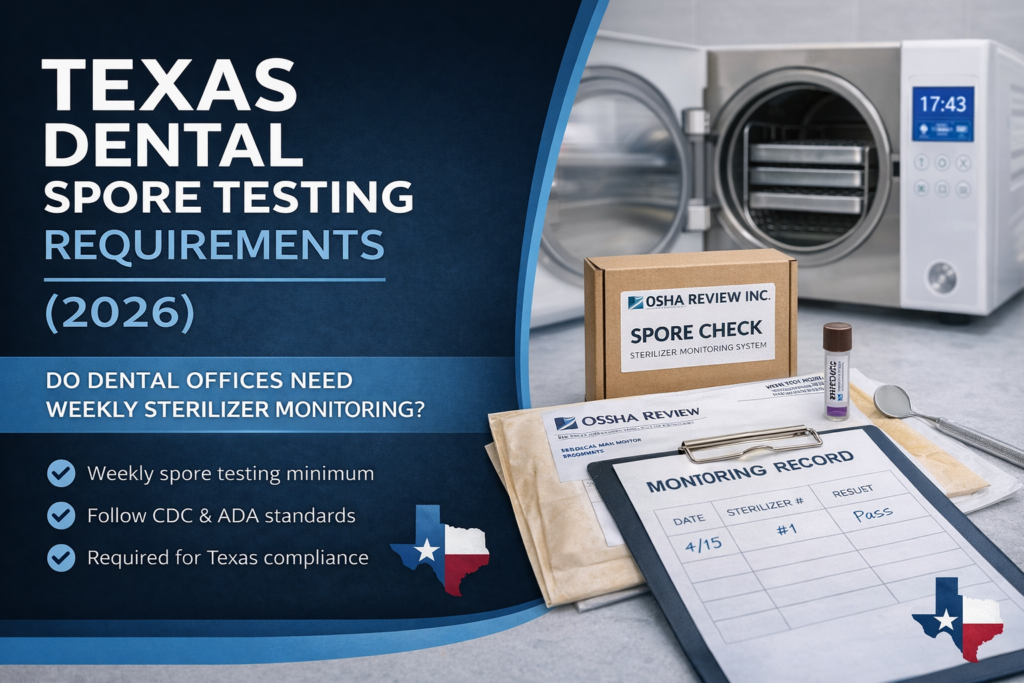
OSHA Review’s Spore Check System is weekly mail-in biological monitoring with the recordkeeping handled for you — the “tested and verified” record § 108.24(b) calls for, produced by an independent lab. Texas Dental Association members can also find it through TDA Perks, the association’s member benefits program.
- Pre-barcoded kits — no lab account to set up
- Laboratory-verified results by email or fax
- Full sterilization history available 24/7 for inspections
- Follow-up reminders if a test is not received within 14 days
- A microbiologist available at no charge if a test comes back positive
See how Texas compares with the rest of the country in our state-by-state sterilizer monitoring guide.
Regulatory Sources
- 22 Tex. Admin. Code § 108.24 — Required Sterilization and Disinfection
- 22 Tex. Admin. Code § 108.21 — Sanitation requirements
- 22 Tex. Admin. Code § 108.22 — Access to Dental Office
- 22 Tex. Admin. Code § 108.7 — Minimum Standard of Care
- 22 Tex. Admin. Code § 108.8 — Records of the Dentist
- Tex. Occ. Code Chapter 263 — Licensing Sanctions
- Tex. Occ. Code Chapter 264 — Administrative Penalties
- ADA — Infection Control and Sterilization
- CDC — Guidelines for Infection Control in Dental Health-Care Settings (2003)
- CDC — Best Practices for Sterilization Monitoring
- 29 C.F.R. § 1910.1030 — Bloodborne Pathogens Standard
- OSHA — State Plans
This guide is general compliance information, not legal advice. Because § 108.24 adopts the ADA’s recommendations, verify current ADA and CDC guidance and the Board’s rules before relying on any summary, including this one.

Related Posts