The October 2026 issue of Dental Bytes covers a flu season reminder for dental teams,…
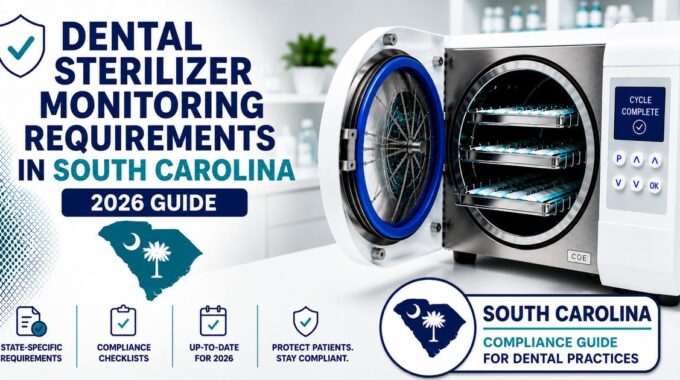
South Carolina Dental Spore Testing Requirements (2026 Guide)
Are South Carolina Dental Offices Required to Perform Spore Testing?
Yes — through the same CDC-incorporation structure used in a handful of other states. S.C. Code Regs. 39-10 (Sanitary Standards) requires that “all dental practices shall conform to and comply with the current recommendations and guidelines of the CDC relating to infection control practices for dentistry and/or dental offices,” and specifically requires that all instruments or equipment used in patient treatment “be sterilized in compliance with the current recommendations of the CDC.” Because current CDC guidance calls for weekly biological (spore) monitoring of every sterilizer, that becomes the practical, Board-enforceable standard for South Carolina dental offices.
Spore testing is one of three types of sterilization monitoring the CDC recommends — mechanical, chemical, and biological. Each confirms something different about a sterilization cycle.
What makes South Carolina worth watching closely right now isn’t the sanitation rule itself — it’s the state’s OSHA enforcement structure sitting under an unusual cloud. South Carolina operates its own OSHA-approved state plan, SC OSHA, but a labor union petitioned federal OSHA in December 2023 to revoke South Carolina’s state-plan authority entirely, citing a failure to maintain an effective enforcement program. Federal OSHA denied the petition but said it would work with the state to address the concerns raised — meaning SC OSHA’s enforcement posture is actively being watched at the federal level, a dynamic no other state in this guide currently faces.
This guide covers what Regulation 39-10 requires, how Board of Dentistry discipline under S.C. Code §40-15-190 works independently of workplace-safety enforcement, what to do if a spore test fails, and how the SC OSHA scrutiny factors into compliance planning.
South Carolina Dental Spore Testing Requirements at a Glance
| Requirement | South Carolina Standard |
|---|---|
| Spore testing requirement | Not stated numerically — required via Reg. 39-10’s mandate to follow current CDC infection control guidelines (weekly biological monitoring) |
| Governing regulation | S.C. Code Regs. 39-10 — Sanitary Standards (Sterilization, subsection 6) |
| Regulating body | South Carolina State Board of Dentistry, under LLR (Department of Labor, Licensing and Regulation) |
| Discipline authority | S.C. Code §40-15-190 — violation of a regulation governing the practice of dentistry as grounds for discipline |
| Personnel scope | Applies to dentists, dental hygienists, and all personnel utilized by a licensed dentist who may be exposed to blood or saliva |
| State OSHA plan | Yes — SC OSHA, but currently under federal scrutiny following a 2023 union petition to revoke the state’s plan authority |
| Enforcement agencies | South Carolina State Board of Dentistry + SC OSHA |
The South Carolina Regulatory Framework for Dental Spore Testing
S.C. Code Regs. 39-10 — Sanitary Standards
South Carolina’s dental-specific sanitation rule doesn’t set a numeric spore testing interval in its own text. Instead, Regulation 39-10 requires dental practices to conform to “the current recommendations and guidelines of the CDC relating to infection control practices,” and separately requires that all instruments and equipment be sterilized “in compliance with the current recommendations of the CDC.” Because CDC guidance calls for weekly biological monitoring of every sterilizer, that becomes the operative, Board-enforceable standard — one that updates automatically if CDC guidance changes, without requiring the state to amend its own regulation.
The rule also extends responsibility beyond the treating dentist: “It is the responsibility of all dentists and dental hygienists licensed by the State and all other personnel who are utilized by a licensed dentist and who assist in a dental practice and may be exposed to body fluids such as blood or saliva to maintain familiarity with these recommendations and guidelines.”
Discipline Under S.C. Code §40-15-190
South Carolina’s Dental Practice Act, at §40-15-190, lists the grounds on which the Board of Dentistry may revoke, suspend, place on probation, or reprimand a license. Violating a regulation governing the practice of dentistry — which includes Regulation 39-10’s sanitary and sterilization standards — falls within the Board’s disciplinary authority, giving the Board a direct enforcement path independent of any workplace-safety action taken separately by SC OSHA.
SC OSHA — A State Plan Under Federal Review
South Carolina operates its own OSHA-approved state plan, SC OSHA, administered through the Department of Labor, Licensing and Regulation. Unlike most state-plan states in this guide, however, SC OSHA’s effectiveness has been formally challenged: in December 2023, the Union of Southern Service Workers petitioned federal OSHA to revoke South Carolina’s state-plan authority, arguing the program had “failed to maintain an effective enforcement program” and citing an enforcement presence that had dropped sharply. Federal OSHA denied the petition but committed to working with the state agency to address the concerns raised, and separate federal litigation over whether South Carolina’s civil penalty levels must match federal OSHA fines has continued. For dental employers, the practical takeaway is not that enforcement is lax — it’s that SC OSHA is operating under closer federal attention than it has in years, which can translate into tighter state-level follow-through going forward.
What South Carolina Dental Offices Must Do
1. Follow Current CDC Infection Control Guidelines
Regulation 39-10 requires compliance with current CDC guidance — in practice, weekly biological (spore) testing of every sterilizer.
2. Test Every Sterilizer Weekly
Run a biological indicator in every sterilizer at least once a week, consistent with the CDC standard the regulation incorporates.
3. Document Every Test
Keep dated records of every spore test and its result — documentation is what demonstrates compliance with Regulation 39-10 if the Board of Dentistry ever asks.
4. Extend Familiarity to All Staff
Ensure every dentist, hygienist, and supervised staff member with potential exposure to blood or saliva maintains familiarity with current CDC infection control guidelines, as Regulation 39-10 requires.
5. Layer in Mechanical and Chemical Indicators
Use a chemical indicator inside every instrument package and monitor time, temperature, and pressure for every load, consistent with CDC guidance.
6. Maintain Bloodborne Pathogens Compliance with SC OSHA
Keep exposure control plans and Bloodborne Pathogens training current — and don’t treat any perceived softness in SC OSHA enforcement as a reason to deprioritize compliance, given the program’s current federal scrutiny.
What to Do If a Spore Test Fails in South Carolina
- Remove the sterilizer from service immediately
- Review loading technique, indicator expiration, and cycle settings for cause
- Retest, or have the unit serviced and retested, before returning it to use
- Document the failure, the corrective action, and the retest result — this record supports compliance with Regulation 39-10 and protects against a §40-15-190 disciplinary finding
For a full step-by-step protocol, see our guide: What Happens If Your Spore Test Fails?
Who Enforces Spore Testing Requirements in South Carolina?
1. South Carolina State Board of Dentistry
Administers Regulation 39-10 and can pursue license discipline under §40-15-190 for violations of regulations governing the practice of dentistry, including sanitary and sterilization standards.
2. SC OSHA
Enforces the Bloodborne Pathogens Standard and related workplace safety requirements through South Carolina’s own state OSHA plan, independent of Board licensure action — though the program’s enforcement effectiveness is currently under federal review following a 2023 revocation petition.
South Carolina Spore Testing Compliance Checklist
✅ Weekly biological spore testing performed on every sterilizer
✅ Matching control indicator run from the same lot
✅ Chemical indicator used inside every instrument package
✅ Mechanical monitoring (time/temperature/pressure) recorded for every load
✅ Dated spore testing log maintained
✅ All staff with blood/saliva exposure familiar with current CDC guidelines
✅ Corrective action documented for any failed spore test
✅ Bloodborne Pathogens Standard compliance maintained for SC OSHA
How Often Should South Carolina Dental Offices Test?
South Carolina’s regulation doesn’t state a numeric interval in its own text — it requires compliance with current CDC guidelines, which today call for weekly biological spore testing of every sterilizer. Because the standard is incorporated by reference, it automatically tracks CDC guidance if that guidance changes.
For a full breakdown of testing frequency best practices, see: How Often Do Dental Offices Need Spore Testing?
Frequently Asked Questions: South Carolina Dental Spore Testing
Does South Carolina law require weekly biological spore testing?
Not by a fixed number in the regulation’s text. S.C. Code Regs. 39-10 requires compliance with current CDC infection control guidelines, and the CDC’s own guidance calls for weekly spore testing — making it the practical, enforceable standard.
What happens if a South Carolina dental office doesn’t perform spore testing?
Noncompliance with the CDC standard incorporated through Regulation 39-10 can support Board of Dentistry discipline under S.C. Code §40-15-190 for violating a regulation governing the practice of dentistry.
Does South Carolina have its own OSHA program?
Yes. South Carolina operates its own OSHA-approved state plan, SC OSHA. However, a 2023 union petition asked federal OSHA to revoke the state’s plan authority over enforcement concerns; federal OSHA denied the petition but is working with the state to address them, so the program remains under closer federal attention than in past years.
Does South Carolina’s sanitary standards regulation apply to dental staff, not just the dentist?
Yes. Regulation 39-10 explicitly extends the CDC-familiarity requirement to dental hygienists and all personnel utilized by a licensed dentist who may be exposed to blood or saliva.
Should South Carolina dental offices expect weaker OSHA enforcement given the scrutiny on SC OSHA?
No — the opposite is more likely. With federal OSHA actively monitoring SC OSHA’s performance following the 2023 revocation petition, dental employers should expect the state program to tighten its enforcement practices rather than relax them.
Stay Compliant with the Spore Check System
The Spore Check System from OSHA Review makes it simple to meet the CDC standard incorporated into S.C. Code Regs. 39-10, with full documentation ready if the Board of Dentistry or SC OSHA ever asks. Our service includes:
✔ Pre-labeled biological indicators mailed directly to your practice
✔ Easy return shipping with prepaid envelopes
✔ Results returned within 24–48 hours
✔ Digital records retained and organized for Board and SC OSHA review
✔ Documentation support that ties directly to Regulation 39-10 compliance
👉 Learn more about the Spore Check System
Regulatory Sources
- S.C. Code Regs. 39-10 — Sanitary Standards: regulations.justia.com
- S.C. Code §40-15-190 — Grounds for discipline of dentist, dental hygienist, or dental technician: law.justia.com
- South Carolina State Board of Dentistry: llr.sc.gov
- SC OSHA State Plan — U.S. Department of Labor, OSHA: osha.gov
- CDC — Guidelines for Infection Control in Dental Health-Care Settings—2003: cdc.gov
See also: Dental Sterilizer Monitoring Requirements by State

Related Posts