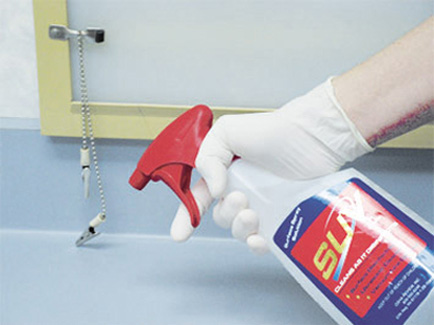
The October 2026 issue of Dental Bytes covers a flu season reminder for dental teams,…
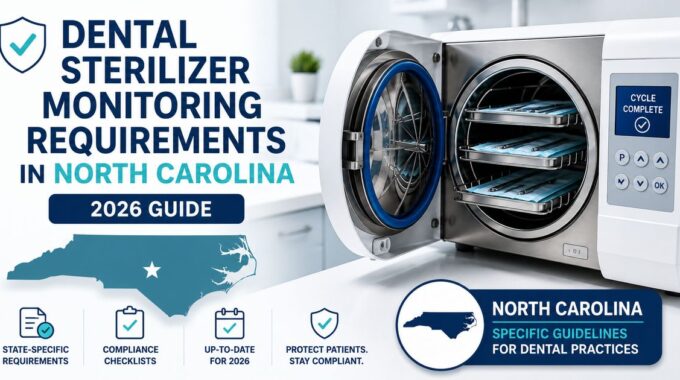
North Carolina Dental Spore Testing Requirements (2026 Guide)
Are North Carolina Dental Offices Required to Perform Spore Testing?
Yes. North Carolina dental offices are legally required to perform weekly biological monitoring (spore testing) of all sterilizers — and the requirement is directly enforceable under state administrative law.
Spore testing is one of three types of sterilization monitoring the CDC recommends — mechanical, chemical, and biological. Each confirms something different about a sterilization cycle.
North Carolina Administrative Code Rule 21 NCAC 16J .0103 requires all dental settings to comply with CDC infection control guidelines, which are explicitly incorporated by reference into state law. Noncompliance is classified as unprofessional conduct under 21 NCAC 16L .0101 — a violation that can result in disciplinary action against your dental license.
The North Carolina Legal Framework for Spore Testing
21 NCAC 16J .0103 — Sterilization and Infection Control
The governing rule, adopted by the North Carolina State Board of Dental Examiners, states:
(b) All settings in which licensees engage in the practice of dentistry or dental hygiene (“dental settings”) shall comply with the recommendations and guidelines of the Centers for Disease Control and Prevention (“CDC”) for infection prevention and control directed at or applicable to dental settings. The CDC recommendations and guidelines are incorporated by reference, including subsequent amendments and editions.
This language — found in 21 NCAC 16J .0103 — is unambiguous: CDC guidelines are not advisory for North Carolina dental practices. They are incorporated into state administrative law and carry the full force of regulation.
The rule also requires:
(a) All instruments or equipment used in the treatment of dental patients shall be sterilized according to manufacturer specifications.
Last amended: June 1, 2021. Authority: G.S. 90-41(a)(23); 90-48; 90-233(a5).
Noncompliance = Unprofessional Conduct
Under 21 NCAC 16L .0101, failure to comply with infection control requirements — including sterilization monitoring — constitutes unprofessional conduct. This means the NC Board of Dental Examiners can take disciplinary action against a dentist’s or hygienist’s license for failing to perform or document spore testing.
This enforcement mechanism makes spore testing compliance in North Carolina more than a best practice — it is a licensure obligation.
NC General Statutes Chapter 90, Article 2
The North Carolina Dental Practice Act grants the Board authority to regulate infection control standards and discipline licensees who fail to meet them. Sterilization compliance falls squarely within this authority.
CDC Standard: At Least Weekly
Because North Carolina explicitly incorporates CDC guidelines by reference, the CDC’s sterilization monitoring requirements are the legal standard for NC dental offices:
“Monitor sterilizers at least weekly by using a biological indicator with a matching control.”
The CDC also requires:
- Mechanical and chemical indicators with every sterilization load
- A biological indicator for every load containing an implantable device
- Immediate corrective action if a spore test fails
- Written sterilization policies and monitoring records
Because 21 NCAC 16J .0103 incorporates these guidelines “including subsequent amendments and editions,” North Carolina practices are bound by the current CDC standard — and any future updates — automatically.
ADA Guidance Aligns with NC Requirements
The American Dental Association supports weekly biological monitoring and emphasizes:
- Testing each sterilizer individually at least once per week
- Immediate corrective action and retesting after a positive result
- Thorough documentation available for board inspection
ADA guidance reinforces what NC law already requires.
How Often Must North Carolina Dental Offices Perform Spore Testing?
Minimum requirement: Once per week per sterilizer.
Additional testing is required or strongly recommended when:
- ✅ A new sterilizer is installed
- ✅ After a sterilizer has been repaired or serviced
- ✅ Following any suspected or confirmed sterilization failure
- ✅ When a biological indicator returns a positive (failed) result — retest before returning the unit to service
Every sterilizer in your office — including backup units — must be tested individually.
👉 For a full breakdown, see: How Often Do Dental Offices Need Spore Testing?
Dual Enforcement: NC Board of Dental Examiners + NC OSHA
North Carolina dental offices face compliance oversight from two regulatory bodies:
1. NC State Board of Dental Examiners (NCSBDE)
The Board can audit infection control policies and sterilization logs during routine or complaint-based inspections. Noncompliance with 21 NCAC 16J .0103 is treated as unprofessional conduct and can result in license suspension, probation, or other disciplinary action.
2. NC OSHA — North Carolina Department of Labor
North Carolina operates its own OSHA-approved state plan covering all private and public dental employers. NC OSHA enforces federal bloodborne pathogen standards (29 CFR 1910.1030) and can inspect sterilization documentation during workplace safety audits.
This dual oversight means North Carolina dental offices must maintain inspection-ready records from two different regulatory angles.
Recordkeeping Requirements
North Carolina dental offices must maintain sterilization monitoring records that are available for inspection by the Board. Your spore testing log should include:
- Date of each test
- Sterilizer identification (each unit logged separately)
- Type of sterilization cycle used
- Test result (pass or fail)
- Name of the person who performed the test
- Any corrective action taken
Best practice is to retain records for a minimum of 3 years, consistent with NC CE documentation retention requirements — though maintaining records longer reduces risk during complaint-based audits.
What Happens If a Spore Test Fails?
A positive (failed) spore test means sterilization effectiveness cannot be confirmed. NC Board expectations and CDC standards require:
- Remove the sterilizer from service immediately
- Review sterilization procedures — check for operator error, overloading, or mechanical failure
- Retest the sterilizer before returning it to use
- If failure is confirmed, keep the unit out of service until inspected and repaired
- Document all corrective actions in your sterilization log
👉 Learn more: What Happens If a Dental Spore Test Fails?
Infection Control CE: Annual Requirement
North Carolina requires infection control continuing education as part of annual license renewal. Unlike most states with multi-year CE cycles, North Carolina licensees renew annually by March 31, making infection control training a recurring yearly obligation.
- Dentists: 15 hours of CE per year, including infection control, ethics/jurisprudence, and CPR/BLS
- Dental Hygienists: 6 hours of CE per year, including infection control and CPR
- All clinical staff: Infection control training required at hire and annually
CE must come from ADA CERP, AGD PACE, or NC Board-approved providers. Records must be retained for at least three years.
Reference: 21 NCAC 16R .0101–.0206
Common North Carolina Compliance Mistakes
- ❌ Not testing backup or secondary sterilizers weekly
- ❌ Missing or incomplete sterilization logs
- ❌ No written infection control protocol on file
- ❌ Delayed corrective action after a failed spore test
- ❌ Failing to test after sterilizer repair or new installation
- ❌ Not documenting the name of the person performing the test
Any of these can be cited as unprofessional conduct under 21 NCAC 16L .0101 during an NC Board inspection.
North Carolina Dental Spore Testing Compliance Checklist
- ✔ Perform weekly spore testing on every sterilizer, including backup units
- ✔ Use a biological indicator — not just chemical or mechanical indicators
- ✔ Maintain a sterilization log with date, sterilizer ID, cycle type, result, and tester name
- ✔ Retain records for a minimum of 3 years
- ✔ Remove sterilizer from service immediately after a positive result
- ✔ Document all corrective actions
- ✔ Follow CDC infection control guidelines (legally required under 21 NCAC 16J .0103)
- ✔ Complete annual infection control CE as required by the NC Board
How OSHA Review Helps North Carolina Dental Offices Stay Compliant
OSHA Review’s Spore Check System gives North Carolina dental practices a simple, reliable way to meet the weekly monitoring requirements of 21 NCAC 16J .0103 — with documentation built in.
With the Spore Check System, you get:
- Weekly mail-in testing kits with fast, lab-verified results
- Organized records ready for NC Board or NC OSHA inspection
- Testing coverage for every sterilizer in your office
- Support for compliance questions
Whether your practice is in Charlotte, Raleigh, Durham, or anywhere across the state, the Spore Check System keeps your sterilization monitoring documented and defensible.
Frequently Asked Questions
Is weekly spore testing required by law in North Carolina?
Yes. 21 NCAC 16J .0103 requires all dental settings to comply with CDC infection control guidelines, which are incorporated by reference into NC administrative law. The CDC requires weekly biological monitoring. Noncompliance is unprofessional conduct under 21 NCAC 16L .0101.
What happens if my practice fails a spore test inspection?
The NC Board of Dental Examiners can initiate disciplinary proceedings for unprofessional conduct. Consequences can include fines, probation, or license suspension depending on the severity and history of noncompliance.
Does every sterilizer need to be tested weekly?
Yes. Each sterilizer must be tested individually, including any backup or secondary units in your office.
How long should North Carolina dental offices keep spore testing records?
Best practice is at least 3 years, consistent with NC CE documentation retention requirements. Maintaining records longer is advisable given that complaint-based audits can look back several years.
Who enforces dental spore testing compliance in North Carolina?
The NC State Board of Dental Examiners enforces infection control compliance under 21 NCAC 16J .0103. NC OSHA enforces bloodborne pathogen standards in the workplace.
Explore Other States
👉 See how North Carolina compares to other states: Dental Sterilizer Monitoring Requirements by State (2026 Guide)
Regulatory Sources
- 21 NCAC 16J .0103 — Sterilization and Infection Control (NC Office of Administrative Hearings)
- North Carolina State Board of Dental Examiners
- NC General Statutes Chapter 90, Article 2 — Dental Practice Act
- NC OSHA — North Carolina Department of Labor
- CDC Best Practices for Sterilization Monitoring in Dental Settings
- ADA Infection Control and Sterilization Guidelines

Related Posts