Do you know how long your dental practice must keep employee medical and exposure records?…
Proper Disposal of Dental Anesthetic Carpules
Dental anesthetic carpules are used every day in most dental practices, but disposing of them correctly depends on what remains inside the glass cartridge after treatment. Understanding the differences can help your office stay compliant with medical waste requirements while protecting employees and waste handlers from injury.
This post is part of our Dental Bytes eNewsletter 2026 hub, where you can access each monthly issue.
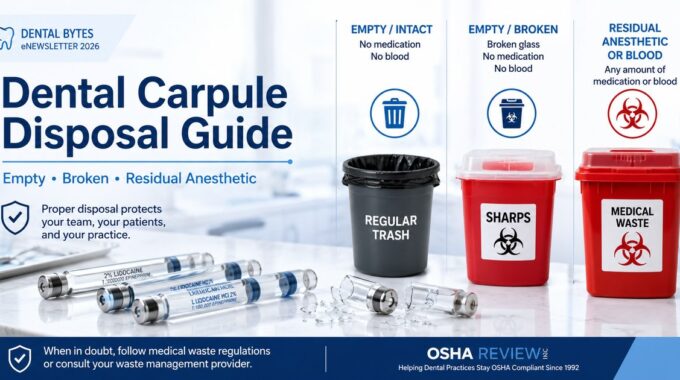
- Empty, Unbroken Carpules: Once a glass carpule has been completely emptied and remains intact, it is no longer considered medical waste. Empty, unbroken carpules may be disposed of in the regular trash.
- Empty, Broken Carpules: Broken glass presents a laceration hazard, even when it does not contain blood or medication. Although an empty broken carpule is generally not considered medical waste unless contaminated with blood, it should never be placed loosely into the trash. Instead, do one of the following:
- Place the broken carpule in the office sharps container.
- First contain the broken glass to eliminate the risk of injury – such as placing it in a rigid plastic container or securely wrapping it with heavy-duty tape – before disposing of it in the regular trash.
Taking these extra precautions helps protect housekeeping personnel and others who handle waste.
- Carpules Containing Residual Anesthetic: If a carpule still contains any amount of anesthetic solution, with or without visible blood, it is considered medical waste, and should be disposed of as such. Do not place partially filled anesthetic carpules into the regular trash or a standard sharps container unless your waste management provider specifically authorizes that method under applicable regulations.
- Carpules Containing Blood Only: If the anesthetic has been fully expelled but the carpule contains visible blood, it is considered medical waste. Dispose of these carpules in a sharps container for disposal through a medical waste hauler or an approved sharps mail-back program.
A Good Office Practice
Training team members on the proper disposal of dental carpules helps ensure regulatory compliance, reduces the risk of needlestick and laceration injuries, and supports a safe workplace for employees, patients, and waste handlers. When in doubt, consult your medical waste hauler or applicable state regulations to confirm the appropriate disposal method for your practice.
For our OSHA Review Subscribers: Additional information about medical waste management can be found in Section IX of your OSHA Review binder.
Frequently Asked Questions
Can I throw an empty, unbroken dental carpule in the trash?
Yes. Once a carpule has been completely emptied and remains intact, it is no longer considered medical waste and may be disposed of in the regular trash.
What should I do with an empty carpule that breaks?
An empty broken carpule is generally not medical waste unless it’s contaminated with blood, but broken glass is a laceration hazard and should never go loose into the trash. Place it in the office sharps container, or first contain the glass — in a rigid plastic container or wrapped securely with heavy-duty tape — before disposing of it in the regular trash.
Does OSHA require dental carpules to be discarded in a sharps container?
Not automatically. OSHA’s bloodborne pathogens standard defines “contaminated sharps” as objects that can penetrate the skin, including broken glass [29 CFR 1910.1030(b)]. In a January 9, 2007 letter of interpretation, OSHA confirmed that intact anesthetic carpules are not considered contaminated sharps and are not required to be discarded in a sharps container — but once a carpule is broken and can puncture skin, it falls under OSHA’s sharps container requirements.
Is a carpule with leftover anesthetic solution considered medical waste?
Yes. If any amount of anesthetic solution remains in a carpule — with or without visible blood — it is considered medical waste. Don’t place partially filled carpules in the regular trash or a standard sharps container unless your waste management provider specifically authorizes that method under applicable regulations.
What if a carpule has visible blood but no anesthetic left inside?
Carpules with visible blood, even after the anesthetic has been fully expelled, are considered medical waste. Dispose of them in a sharps container for pickup by a medical waste hauler or through an approved sharps mail-back program.
Related OSHA Review Resources
- Dental Bytes eNewsletter 2026 Hub
- OSHA Review Compliance Program
- OSHA Bloodborne Pathogens Standard (29 CFR 1910.1030)
- OSHA Letter of Interpretation: Dental Anesthetic Carpules as Contaminated Sharps/Regulated Waste (2007)
About OSHA Review, Inc.
Since 1992, OSHA Review, Inc. has supported dental professionals with regulatory compliance resources, infection control guidance, continuing education, sterilizer monitoring, surface disinfectant products, and dosimetry monitoring services. For more information, visit oshareview.com or call 800-555-6248.
This post is part of the Dental Bytes eNewsletter 2026 series. Visit the hub to access all monthly updates.

Related Posts