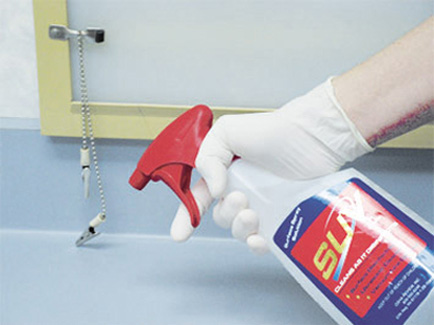
The October 2026 issue of Dental Bytes covers a flu season reminder for dental teams,…
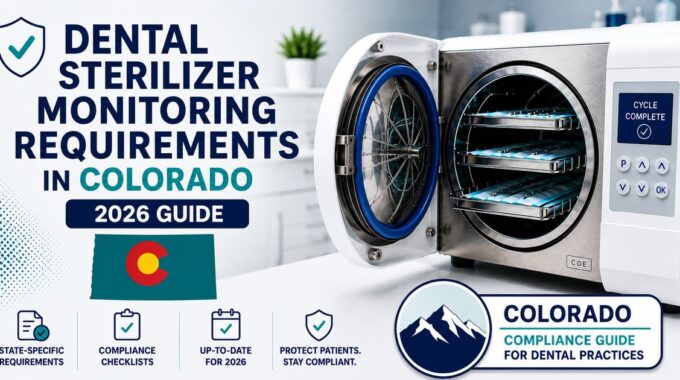
Colorado Dental Spore Testing Requirements (2026 Guide)
Are Colorado Dental Offices Required to Perform Spore Testing?
Yes. Colorado dental offices are required to perform biological monitoring (spore testing) of all heat sterilizing devices under 3 CCR 709-1.16 — the infection control rule of the Colorado Dental Board. The rule mandates compliance with the CDC’s 2003 “Guidelines for Infection Control in Dental Health-Care Settings” and the CDC’s October 2016 “Summary of Infection Prevention Practices in Dental Settings,” both of which establish weekly biological monitoring as the minimum standard for dental sterilizers.
Spore testing is one of three types of sterilization monitoring the CDC recommends — mechanical, chemical, and biological. Each confirms something different about a sterilization cycle.
Colorado’s rule does not state “weekly” in its own text — the frequency requirement flows from the CDC guidelines that 3 CCR 709-1.16 incorporates by reference. The Colorado Dental Board enforces these requirements under C.R.S. §§ 12-220-201 and 12-220-202, and violations constitute unprofessional conduct subject to license discipline. The rule applies to dentists, dental therapists, and dental hygienists — and each licensee is also responsible for the compliance of any unlicensed dental personnel under their supervision.
Colorado does not have a state OSHA plan. Federal OSHA — including the Bloodborne Pathogens Standard (29 CFR 1910.1030) — applies directly to all Colorado dental practices. 3 CCR 709-1.16 explicitly incorporates OSHA’s Bloodborne Pathogens Standard alongside the CDC guidelines, giving Colorado dental practices two interlocking compliance frameworks: Board of Dentistry licensure rules and federal OSHA workplace safety requirements.
This guide covers the full Colorado framework — what 3 CCR 709-1.16 requires, the CDC standards incorporated by reference, what happens when a spore test fails, and how enforcement works.
Colorado Dental Spore Testing Requirements at a Glance
| Requirement | Colorado Standard |
|---|---|
| Spore testing frequency | At least weekly per CDC guidelines (incorporated by reference under 3 CCR 709-1.16) |
| Control indicator | Required per CDC guidelines (same lot number as test indicator) |
| Implantable devices | Biological indicator required for every load; hold implantable until negative result confirmed |
| Chemical indicators | Required inside every instrument package per CDC guideline (incorporated by reference) |
| Mechanical monitoring | Required every load per CDC guideline (incorporated by reference) |
| Record retention | Not specified in rule text; CDC best practices and OSHA documentation requirements apply |
| Governing regulation | 3 CCR 709-1.16 (Colorado Dental Board) + Federal OSHA BBP Standard (29 CFR 1910.1030) |
| Enforcement agencies | Colorado Dental Board + Federal OSHA |
The Colorado Regulatory Framework for Dental Spore Testing
3 CCR 709-1.16 — The Infection Control Rule
The core Colorado dental spore testing requirement is found in 3 CCR 709-1.16, the infection control rule promulgated by the Colorado Dental Board under authority of C.R.S. §§ 12-20-204, 12-220-105(3), and 12-220-106. The rule states:
“In addition to meeting applicable standards of care, dentists, dental therapists and dental hygienists must follow, and the Board incorporates by reference the following standards: 1) the Centers for Disease Control and Prevention (CDC) 2003 ‘Guidelines for Infection Control in Dental Health-Care Settings’… as supplemented by the Centers for Disease Control and Prevention, Summary of Infection Prevention Practices in Dental Settings: Basic Expectations for Safe Care… October 2016; and 2) the Occupational Safety and Health Administration’s (OSHA) Bloodborne Pathogens Standard (29 CFR 1910.1030)…”
The rule was last amended November 3, 2022, effective December 30, 2022. It applies to all licensed dentists, dental therapists, and dental hygienists in Colorado. Critically, it extends responsibility downward: each licensee is also responsible for the compliance of unlicensed dental personnel they supervise — meaning the dentist cannot delegate sterilization monitoring to an unlicensed assistant and avoid accountability if that monitoring is absent or inadequate.
Colorado’s approach is incorporation by reference rather than enumeration. The Board does not restate the CDC’s specific requirements in its own rule text — instead, it makes the entire CDC guideline and 2016 summary legally binding. This means every requirement in those documents carries the same force as if it were written into Colorado’s administrative code.
What the Incorporated CDC Guidelines Require
Because 3 CCR 709-1.16 makes CDC guidelines legally binding in Colorado, the CDC’s sterilization monitoring requirements are Colorado’s requirements. The CDC’s 2003 guidelines and 2016 summary establish three layers of sterilization monitoring:
Biological Monitoring (Spore Testing) — At Least Weekly
The CDC guidelines require biological indicators to be used at least weekly to monitor sterilizers. Each test must use a matching control indicator from the same lot number to verify that the incubator is functioning correctly and the indicators are viable. A biological indicator must also be used for every sterilizer load containing an implantable device, and the implantable must be held until a negative result is confirmed.
Chemical Indicators — Every Package, Every Load
A chemical indicator must be placed inside every instrument package to confirm that sterilization conditions were reached. If the internal indicator is not visible from outside the package, an external indicator must also be used. No package should be used if the chemical indicator shows inadequate processing.
Mechanical Monitoring — Every Load
Time, temperature, and pressure parameters must be verified and recorded for every sterilizer cycle. Mechanical monitoring is the first line of detection when a cycle runs outside specification. It does not substitute for biological monitoring, but its record is an essential part of any documentation review.
Federal OSHA — The Second Compliance Framework
Colorado is a federal OSHA state — it does not have an approved state OSHA plan. This means the U.S. Occupational Safety and Health Administration directly regulates all Colorado dental practices under the federal Bloodborne Pathogens Standard (29 CFR 1910.1030). 3 CCR 709-1.16 explicitly incorporates this standard alongside the CDC guidelines.
Under federal OSHA, Colorado dental practices must maintain:
- A written Exposure Control Plan, updated annually and accessible to all employees
- Engineering and work practice controls to minimize employee exposure to bloodborne pathogens and other potentially infectious materials (OPIM)
- Documentation of sterilization procedures as part of the Exposure Control Plan
- Annual employee training on bloodborne pathogen risks, controls, and post-exposure procedures
- Post-exposure evaluation and follow-up procedures
Federal OSHA inspections of Colorado dental practices — both programmed and complaint-triggered — review sterilization records, Exposure Control Plans, training documentation, and PPE compliance. A practice with absent or inconsistent spore test records can face federal OSHA citations in addition to Colorado Dental Board discipline.
What Colorado’s Spore Testing Rule Actually Requires
3 CCR 709-1.16 incorporates the CDC guidelines in full, which means Colorado dental practices must maintain all three layers of sterilization monitoring simultaneously. Here is what that looks like in practice:
1. Biological Monitoring (Spore Testing) — Weekly Minimum
Every heat sterilizing device in a Colorado dental office must be tested using a biological indicator appropriate to the sterilization process — typically Geobacillus stearothermophilus for steam autoclaves. Testing must occur at least weekly, and each test must run alongside a matching control indicator from the same lot to verify incubator function and indicator viability. Testing with a third-party mail-in service, such as OSHA Review’s Spore Check System, provides independent documentation and removes incubator error as a variable in your results.
2. Chemical Indicators — Every Package, Every Load
A chemical indicator must be placed inside every instrument package processed through the sterilizer. If the indicator is not visible from outside the package, an external indicator is also required. A package whose chemical indicator shows inadequate processing must not be used — the load should be re-processed after the cause is identified.
3. Mechanical Monitoring — Every Load
Time, temperature, and pressure must be verified and recorded for every sterilizer cycle. Mechanical monitoring does not replace biological monitoring but provides the first alert when a cycle runs outside parameters and creates the baseline documentation for any compliance review.
Special situations requiring immediate biological monitoring:
- After any sterilizer repair — run a biological indicator before returning the unit to service
- For every load containing an implantable device — hold the implantable until a negative result is confirmed
- After any change in sterilizer loading pattern, packaging, or cycle parameters
- After a new sterilizer is installed or relocated
What to Do If a Spore Test Fails in Colorado
3 CCR 709-1.16 does not define a specific positive-result protocol — that detail is governed by the CDC guidelines incorporated by reference. The CDC’s recommended response to a positive (failed) biological indicator is:
Immediate response:
- Remove the sterilizer from service — do not process additional instrument loads until the issue is resolved
- Investigate the cause — check loading technique, cycle parameters, indicator lot number and expiration, and incubator function
- Re-test immediately — run a new biological indicator with a fresh control using correct loading procedures to confirm or rule out equipment failure
- Document all steps — record the positive result, the investigation steps, and the re-test result
If the re-test is also positive:
- Keep the sterilizer out of service — arrange for inspection and repair by a qualified service technician
- Evaluate patient notification — identify patients treated with instruments from potentially non-sterile loads and assess whether notification or recall is appropriate
- Maintain repair documentation — keep technician service records with your spore testing log
- Do not return to service until passing — confirm with a negative biological indicator result after repair before resuming normal use
For a complete step-by-step protocol, see our full guide: What Happens If Your Spore Test Fails?
Record-Keeping for Colorado Dental Spore Testing
3 CCR 709-1.16 does not specify a minimum record retention period for spore testing documentation. However, record-keeping obligations flow from two sources. First, the CDC guidelines incorporated by reference identify sterilization monitoring records as an essential component of a dental infection prevention program — documentation demonstrates that cycle parameters were met and establishes accountability for each load. Second, federal OSHA requires that records related to the Bloodborne Pathogens Standard be maintained for the duration of employment plus 30 years for employee medical records, and that training records be kept for three years.
In the absence of a state-specified retention period, a minimum of three years of spore testing records is a sound baseline for Colorado dental practices — long enough to satisfy federal OSHA training record requirements and to cover any inspection or complaint investigation window.
For each spore test entry, document:
- Date the test was performed
- Sterilizer ID or serial number (if multiple units in the practice)
- Biological indicator lot number and expiration date
- Control indicator result
- Test indicator result (pass / fail)
- Name of the person who performed the test
- If a positive result: corrective actions taken, re-test result, and repair documentation if applicable
See also: Dental Sterilizer Monitoring Requirements by State
Who Enforces Spore Testing Requirements in Colorado?
1. Colorado Dental Board
The Colorado Dental Board, housed within the Colorado Department of Regulatory Agencies (DORA), administers 3 CCR 709-1 and enforces infection control requirements for all licensed dental professionals in Colorado. Under C.R.S. § 12-220-201 (Grounds for disciplinary action) and C.R.S. § 12-220-202 (Disciplinary actions), the Board can discipline any licensee for violations of the rules — including failure to follow the CDC and OSHA standards incorporated by reference in 3 CCR 709-1.16. Sanctions include license suspension, revocation, probation, fines, and mandated remedial education. The Board may initiate complaints on its own motion and investigates complaints submitted by any person in writing.
2. Federal OSHA
Federal OSHA directly enforces the Bloodborne Pathogens Standard (29 CFR 1910.1030) in all Colorado dental practices. OSHA inspections — both scheduled and complaint-triggered — review Exposure Control Plans, sterilization records, employee training documentation, and PPE compliance. Violations can result in monetary penalties. A practice with absent spore test records or an inadequate Exposure Control Plan faces citations independent of any Board of Dentistry proceeding.
Colorado Spore Testing Compliance Checklist
✅ All heat sterilizing devices tested with a biological indicator at least weekly (CDC guideline, incorporated by 3 CCR 709-1.16)
✅ Matching control indicator (same lot number) run alongside every biological monitoring test
✅ Biological indicator used for every load containing an implantable device; implantable held until negative result confirmed
✅ Chemical indicator placed inside every instrument package
✅ External chemical indicator added to any package where internal indicator is not visible
✅ Mechanical monitoring (time, temperature, pressure) recorded for every sterilizer cycle
✅ Positive result protocol followed: sterilizer removed from service, re-tested, and repaired before return to service
✅ Spore test log maintained for a minimum of three years with test results, lot numbers, and responsible staff member
✅ Unlicensed dental personnel supervised and trained to comply with 3 CCR 709-1.16 requirements
✅ Written Exposure Control Plan in place and updated annually (federal OSHA)
✅ All staff who process instruments trained on sterilization monitoring procedures
✅ Biological indicators stored per manufacturer specifications and used before expiration
How Often Should Colorado Dental Offices Test? A Closer Look
3 CCR 709-1.16 does not state “weekly” in Colorado’s regulatory text — the weekly requirement comes from the CDC guidelines the rule incorporates by reference. That standard is what the Colorado Dental Board expects, and it is the floor — not the target — for most practices.
Consider testing more often than weekly if:
- Your practice processes high instrument volumes across multiple providers daily
- Your sterilizer is older or has a recent history of mechanical issues
- A new team member has recently taken over sterilization duties
- You have recently experienced a chemical or mechanical indicator anomaly
- Your practice is preparing for a Board of Dentistry review or federal OSHA inspection
For more on testing frequency best practices, see: How Often Do Dental Offices Need Spore Testing?
Frequently Asked Questions: Colorado Dental Spore Testing
Is biological spore testing legally required in Colorado?
Yes. 3 CCR 709-1.16 requires all Colorado dentists, dental therapists, and dental hygienists to comply with the CDC’s 2003 guidelines and 2016 summary, which mandate weekly biological monitoring of all dental sterilizers. Failure to perform or document biological monitoring can constitute unprofessional conduct under C.R.S. § 12-220-201 and result in Colorado Dental Board discipline.
Does Colorado require weekly spore testing specifically?
Colorado’s rule does not use the word “weekly” in its text. However, 3 CCR 709-1.16 incorporates the CDC guidelines by reference and makes them legally binding — and the CDC guidelines establish at least weekly biological monitoring as the minimum standard. That is what the Colorado Dental Board expects.
Does Colorado have a state OSHA plan?
No. Colorado is a federal OSHA state. Federal OSHA directly enforces the Bloodborne Pathogens Standard (29 CFR 1910.1030) in all Colorado dental practices. There is no separate Colorado OSHA agency for private-sector enforcement.
How long do we need to keep spore test records in Colorado?
3 CCR 709-1.16 does not specify a retention period. A minimum of three years is a sound baseline, consistent with federal OSHA training record requirements and typical compliance audit windows. Records should be readily available in the dental office for any inspection or complaint investigation.
Who is responsible if unlicensed staff perform sterilization monitoring incorrectly?
The licensed dentist. 3 CCR 709-1.16 explicitly states that “a licensee is also responsible for the compliance of unlicensed dental personnel.” If an unlicensed assistant fails to perform or document spore testing, the supervising licensee bears responsibility for that failure under the Board’s rules.
Can we use an in-office incubator, or is a mail-in service required?
Colorado does not require mail-in testing. In-office incubators are permitted. A third-party mail-in service provides independent documentation and removes incubator malfunction as a variable in your results — particularly useful when investigating a positive result.
What happens if a Colorado dental office has no spore test records?
Absent documentation is treated as absent compliance. If the Colorado Dental Board receives a complaint or initiates a review, the inability to produce spore test records for the relevant period constitutes evidence of non-compliance with 3 CCR 709-1.16. Federal OSHA inspectors face the same issue. In both cases, the licensee bears the consequence.
Are Colorado dental hygienists subject to the same infection control rules?
Yes. 3 CCR 709-1.16 applies to dentists, dental therapists, and dental hygienists. All three license categories are required to follow the incorporated CDC and OSHA standards.
Stay Compliant with the Spore Check System
The Spore Check System from OSHA Review makes weekly spore testing simple, fully documented, and immediately retrievable for Colorado dental practices. Our service includes:
- ✔ Pre-labeled biological indicators mailed directly to your practice
- ✔ Easy return shipping with prepaid envelopes
- ✔ Results returned within 24–48 hours
- ✔ Digital records stored and accessible for Colorado Dental Board inquiries and federal OSHA inspections
- ✔ Positive result support — guidance on next steps when a test fails
👉 Learn more about the Spore Check System
Regulatory Sources
- 3 CCR 709-1.16 — Infection Control: law.cornell.edu
- C.R.S. § 12-220-201 — Grounds for disciplinary action: colorado.public.law
- C.R.S. § 12-220-202 — Disciplinary actions: colorado.public.law
- Colorado Dental Board: dpo.colorado.gov
- CDC — Summary of Infection Prevention Practices in Dental Settings: cdc.gov
- Federal OSHA — Bloodborne Pathogens Standard (29 CFR 1910.1030): osha.gov

Related Posts