The October 2026 issue of Dental Bytes covers a flu season reminder for dental teams,…
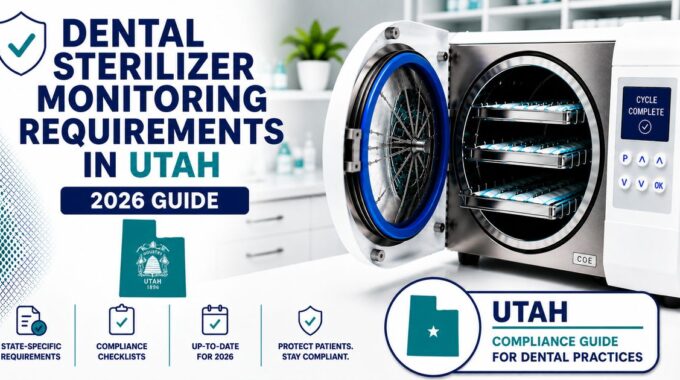
Utah Dental Spore Testing Requirements (2026 Guide)
Are Utah Dental Offices Required to Perform Spore Testing?
Yes — but Utah takes a genuinely different regulatory path than most states in this guide to get there. Unlike states that name the CDC’s infection control guidelines directly, Utah’s dental practice act contains no dedicated infection control or sterilization rule with a numeric testing interval. Instead, Utah Code § 58-69-502(1)(d) defines “unprofessional conduct” to include “failing to maintain facilities, instruments, equipment, supplies, appliances, or other property or conditions related to the practice of dentistry in a sanitary condition consistent with the standards and ethics of the professions of dentistry or dental hygiene.” Because the CDC’s weekly biological (spore) testing recommendation is the accepted professional standard, failing to test weekly can be treated as failing to meet this sanitary-condition standard — and therefore as unprofessional conduct.
Spore testing is one of three types of sterilization monitoring the CDC recommends — mechanical, chemical, and biological. Each confirms something different about a sterilization cycle.
Utah backs this open-ended standard with a direct inspection-access provision: 58-69-502(1)(c) makes it unprofessional conduct to refuse authorized agents of the Division or state or local health authorities access to a dental facility during normal business hours for the purpose of inspection. That combination — a standards-and-ethics sanitary condition rule plus a standalone duty to allow inspection — is a structurally different approach than the CDC-incorporation-by-reference model used by most states in this guide.
This guide covers how Utah’s unprofessional conduct statute functions as its infection control standard, how inspection access ties into it, what to do if a spore test fails, and how Utah’s own state OSHA program, UOSH, adds a second layer of enforcement.
Utah Dental Spore Testing Requirements at a Glance
| Requirement | Utah Standard |
|---|---|
| Spore testing requirement | Not stated numerically anywhere in statute or rule — enforced via the general “sanitary condition” standard for unprofessional conduct |
| Governing statute | Utah Code § 58-69-502(1)(d) — Unprofessional Conduct (Dentist and Dental Hygienist Practice Act) |
| Inspection access | 58-69-502(1)(c) — refusing Division or health authority inspection access during business hours is itself unprofessional conduct |
| Regulating body | Utah Division of Professional Licensing (DOPL) |
| Structural note | No dedicated administrative rule (R156-69) section names CDC guidelines or a numeric testing interval, unlike most states in this guide |
| General discipline standard | Utah Code § 58-1-501 — gross incompetence, gross negligence, or a pattern of incompetency or negligence |
| State OSHA plan | Yes — Utah Occupational Safety and Health (UOSH), under the Utah Labor Commission |
| Enforcement agencies | Utah DOPL + UOSH |
The Utah Regulatory Framework for Dental Spore Testing
Utah Code § 58-69-502(1)(d) — The Sanitary Condition Standard
Rather than adopting the CDC’s infection control guidelines by reference or stating a numeric testing interval in an administrative rule, Utah folds infection control into its unprofessional conduct statute. Section 58-69-502(1)(d) makes it unprofessional conduct to fail to maintain instruments, equipment, and facilities “in a sanitary condition consistent with the standards and ethics of the professions of dentistry or dental hygiene.” Because weekly biological spore testing is the accepted professional standard for verifying sterilizer effectiveness, a Utah dentist who skips or fails to document spore testing is exposed to discipline under this open-ended standard, even though no Utah rule spells out “weekly” in so many words.
Inspection Access Is Its Own Unprofessional Conduct Provision
Section 58-69-502(1)(c) separately makes it unprofessional conduct to refuse authorized agents of the Division, or state or local health authorities, access to a dental facility during normal business hours for inspection purposes. This gives Utah regulators a direct enforcement lever: a dentist who blocks a compliance inspection commits a separate act of unprofessional conduct, independent of whatever the inspection might have found.
Backed by the General Negligence and Incompetence Standard
Utah Code § 58-1-501, which applies across all professions regulated by DOPL, defines unprofessional conduct to include practicing through gross incompetence, gross negligence, or a pattern of incompetency or negligence. This general provision reinforces 58-69-502(1)(d): a documented pattern of failing to test or maintain sterilization equipment could support discipline under either provision.
UOSH — A State-Run OSHA Program
Utah operates its own OSHA-approved state plan, Utah Occupational Safety and Health (UOSH), administered by the Utah Labor Commission. UOSH adopts most federal OSHA standards and periodically supplements them with additional Utah-specific requirements, giving Utah dental offices a state-based point of contact for Bloodborne Pathogens Standard enforcement, independent of DOPL’s licensure oversight.
What Utah Dental Offices Must Do
1. Test Every Sterilizer Weekly to Meet the Sanitary Condition Standard
Run a biological spore test on every sterilizer at least weekly, consistent with the accepted professional standard that 58-69-502(1)(d) references indirectly.
2. Allow Inspection Access During Business Hours
Never refuse a Division agent or health authority access to your facility during normal business hours — doing so is unprofessional conduct on its own under 58-69-502(1)(c).
3. Document Every Test
Keep dated records of every spore test and its result. Because Utah’s standard is open-ended rather than numeric, documentation is what demonstrates that your practice meets the sanitary-condition standard.
4. Maintain All Equipment and Facilities in Sanitary Condition
Extend the same standard to instruments, supplies, appliances, and the facility itself, not just sterilizers.
5. Layer in Mechanical and Chemical Indicators
Use a chemical indicator inside every instrument package and monitor time, temperature, and pressure for every load.
6. Maintain Bloodborne Pathogens Compliance with UOSH
Keep exposure control plans and Bloodborne Pathogens training current for Utah’s own state OSHA program.
What to Do If a Spore Test Fails in Utah
- Remove the sterilizer from service immediately
- Review loading technique, indicator expiration, and cycle settings for cause
- Retest, or have the unit serviced and retested, before returning it to use
- Document the failure, the corrective action, and the retest result — this record is exactly what demonstrates compliance with the sanitary-condition standard under 58-69-502(1)(d)
For a full step-by-step protocol, see our guide: What Happens If Your Spore Test Fails?
Who Enforces Spore Testing Requirements in Utah?
1. Utah Division of Professional Licensing (DOPL)
Administers Utah Code § 58-69-502 and can pursue license discipline for failing to maintain a sanitary condition, refusing inspection access, or a pattern of incompetency or negligence under 58-1-501.
2. Utah Occupational Safety and Health (UOSH)
Enforces the Bloodborne Pathogens Standard and related workplace safety requirements through Utah’s own state OSHA plan, administered by the Utah Labor Commission, independent of DOPL licensure action.
Utah Spore Testing Compliance Checklist
✅ Weekly biological spore testing performed on every sterilizer
✅ Matching control indicator run from the same lot
✅ Chemical indicator used inside every instrument package
✅ Mechanical monitoring (time/temperature/pressure) recorded for every load
✅ Dated spore testing log maintained
✅ Facilities, instruments, and equipment kept in sanitary condition
✅ Inspection access never refused to Division or health authority agents
✅ Bloodborne Pathogens Standard compliance maintained for UOSH
How Often Should Utah Dental Offices Test?
Utah’s statute doesn’t state a numeric interval anywhere — it relies on the “standards and ethics of the professions of dentistry or dental hygiene” to define what a sanitary condition requires. Because weekly biological spore testing is the accepted professional standard nationally, that’s the practical benchmark Utah dental offices should meet, even though no Utah rule spells it out in a specific number.
For a full breakdown of testing frequency best practices, see: How Often Do Dental Offices Need Spore Testing?
Frequently Asked Questions: Utah Dental Spore Testing
Does Utah law require weekly biological spore testing?
Not by a specific number written into any Utah statute or rule. Utah Code § 58-69-502(1)(d) requires facilities, instruments, and equipment be maintained in a sanitary condition consistent with professional standards and ethics — and weekly spore testing is the accepted professional standard that satisfies this.
Does Utah have a dedicated infection control rule like other states?
No. Utah’s dental practice act rule (R156-69) does not contain a section naming CDC guidelines or a numeric testing interval, which is a structurally different approach than most states in this guide.
What happens if a Utah dental office refuses an inspection?
Refusing authorized Division or health authority agents access to a dental facility during normal business hours is itself unprofessional conduct under 58-69-502(1)(c), regardless of what the inspection might have found.
Does Utah have its own OSHA program?
Yes. Utah operates its own OSHA-approved state plan, UOSH, administered by the Utah Labor Commission.
What happens if a Utah dental office doesn’t perform spore testing?
Failing to test can support a finding of unprofessional conduct under 58-69-502(1)(d) for failing to maintain a sanitary condition, or under the general gross negligence/incompetence standard in 58-1-501.
Stay Compliant with the Spore Check System
The Spore Check System from OSHA Review makes it simple to meet the sanitary-condition standard behind Utah Code § 58-69-502(1)(d), with full documentation ready if DOPL or UOSH ever asks. Our service includes:
✔ Pre-labeled biological indicators mailed directly to your practice
✔ Easy return shipping with prepaid envelopes
✔ Results returned within 24–48 hours
✔ Digital records retained and organized for DOPL and UOSH review
✔ Documentation support built to demonstrate professional-standard compliance
👉 Learn more about the Spore Check System
Regulatory Sources
- Utah Code § 58-69-502 — Unprofessional conduct: law.justia.com
- Utah Code § 58-1-501 — Unlawful and unprofessional conduct: lawserver.com
- Utah Division of Professional Licensing (Dentistry): commerce.utah.gov
- Utah Occupational Safety and Health (UOSH) — Utah Labor Commission: laborcommission.utah.gov
- CDC — Guidelines for Infection Control in Dental Health-Care Settings—2003: cdc.gov
See also: Dental Sterilizer Monitoring Requirements by State

Related Posts